The Southeast’s Untapped Potential: Agrivoltaics, Policy, and the Path Forward
Other states fund agrivoltaics with tax breaks, grants, and pilot programs. See why the Southeast lags behind — and what's needed to close the incentive gap.
Article|08.04.2026
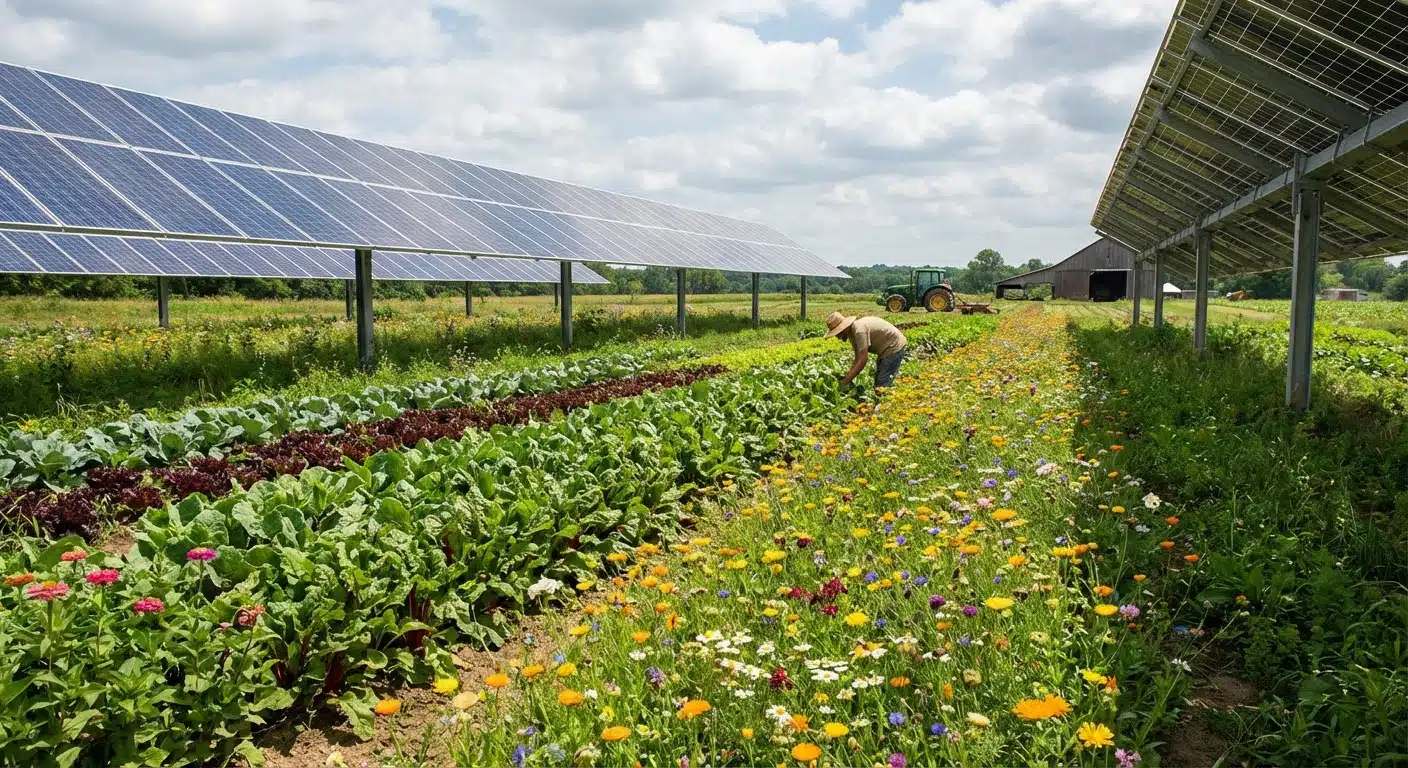
Agrivoltaics, the practice of co-locating agriculture and solar energy systems, is growing in popularity in the United States and around the world. Farmers and solar developers are working together to discover the benefits of solar beyond clean energy production. Incorporating agricultural practices with a solar energy system typically raises project costs, but well-crafted incentive programs and dedicated research can help us address the financial barriers that are currently slowing or preventing the proliferation of agrivoltaics. Policymakers have an important role to play in this work; government support is key to advancing agrivoltaics.
671 agrivoltaic sites cataloged by the National Laboratory of the Rockies generate over 13 GW of electricity. The true number, which includes unreported sites, is likely far greater.
Government Support for Agrivoltaics in the Southeast
There is currently no state policy or regulatory mandate for agrivoltaics in the Southeast; instead, our region relies on a combination of technical guidance, frameworks, and voluntary initiatives. These programs, which exist in North & South Carolina, Georgia, and Florida, in different forms, are designed to encourage solar developers to integrate agricultural benefits — primarily pollinator habitats — into their project designs without the pressure of strict legal requirements. By providing a structured path for certification and best practices, these states aim to balance rapid renewable energy expansion with the preservation of local ecosystems and agricultural productivity.
South Carolina and North Carolina have both established prominent voluntary pollinator programs that serve as regional models. In South Carolina, theSC Solar Habitat Act was signed into law on June 1, 2018, following the 2018 legislative session. Administered by the Department of Natural Resources (DNR), the Act provides a formal framework and guidance for a voluntary solar habitat certification program. North Carolina’s efforts are spearheaded by thePollinator Conservation Alliance. The state provides comprehensive resources, including the NC Solar Technical Guidance and the Solar Farm Monitoring Report, to help developers implement and maintain effective pollinator-friendly practices on solar sites.
Georgia and Florida also follow this guidance-based approach. Georgia utilizes the Recommended Practices for the Responsible Siting and Design of Solar Development in Georgia, a collaborative effort involving the Georgia DNR Wildlife Resources Division, the U.S. Fish and Wildlife Service, and the Georgia DNR Environmental Protection Division. This document specifically highlights agrivoltaics and pollinators as key considerations for responsible development. In Florida, the focus is on a specialized Scorecard system to measure the efficacy of solar habitats. This program is administered through a partnership of academic and scientific institutions, including the University of Florida (UF) IFAS Extension, the UF departments of Entomology and Meteorology, and the Florida Museum, ensuring that voluntary initiatives are backed by rigorous scientific standards.
These Southeastern states have demonstrated the collaboration needed to create a framework that supports agrivoltaics. With the help of state policymakers, research universities, innovative solar developers, and agricultural experts, we can create transformational agrivoltaics policies that consider livestock grazing, pollinator habitats, and crop production.
Incentives for Agrivoltaics
In other parts of the country, there are financial incentives for agrivoltaics projects. This is one distinct difference between what we have in the Southeast, where guidance for co-locating solar is all that exists.
States across the country are taking various approaches to financially support agrivoltaics. While some states have passed legislation defining agrivoltaics, others are using the following policy levers to support farmers and increase clean energy generation in their state:
Feed-in tariff model: Massachusetts provides direct compensation to agricultural land owners with an adder of $0.09/kWh through the Solar Massachusetts Renewable Target (SMART) program.
Tax benefits: Maryland provides farmers and developers with personal property tax exemptions for agrivoltaics projects.
Research funding: Colorado’s Department of Agriculture awards grants for agrivoltaics research and demonstration projects.
Pilot Programs: New Jersey established a three-year Dual Use Solar Energy Pilot Program to bolster agrivoltaics research while also adding 200 MW of solar in the state.
Colorado promotes agrivoltaics through a combination of the policies listed above. The state legislature passed Senate Bill 23-092 in 2023 to create a funding mechanism for agrivoltaics research and demonstration projects. The Colorado Department of Agriculture has awarded a total of $1.3 million over the last three years. In addition to grant funding, Colorado has also carved out a property tax exemption for farming and solar equipment used for agrivoltaics.
Southeast Policy Obstacles
Solar energy as a whole has faced an uphill battle in rural communities and among legislators representing rural constituencies in the Southeast. Without a sustained welcoming environment for solar development in our region, policies supporting solar energy projects, with or without an agricultural production component, are few and far between. This is a large part of why, in this part of the nation with high solar potential, transformative incentives for solar do not exist in every state. This peculiarity can also be partially attributed to the unique electric power market in the Southeast where vertically integrated utilities operate as regulated monopolies.
As we point out every year in SACE’s “Solar in the Southeast” Report, a couple of states are leading the charge in this area, while others consistently fall behind. Florida and North Carolina were early adopters of policies that created a favorable environment for solar. In 2007, Florida passed bipartisan legislation requiring the Public Service Commission and utilities to offer net metering. That same year, North Carolina became the first state in the Southeast to adopt renewable portfolio standards. All of which makes it unsurprising that both states lead the region in installed solar capacity.
All of our Southeastern states, even the leaders, have a long way to go in the realm of solar energy policy, but agrivoltaics progress is still being made. Livestock grazing is the primary form of agrivoltaics in the Southeast currently. In fact, Tennessee-based renewable energy developer Silicon Ranch has the largest wholly-owned agrivoltaics portfolio in the country. The company is also leading the way for innovative agrivoltaics research. The nation’s first commercial site with solar production and cattle grazing first began as a years-long research initiative for the company.
Our region has the resources needed to create meaningful agrivoltaics policies and incentives. With concerted awareness and education efforts, we can get there.
Federal Solar Project Hurdles
The expansion of agrivoltaics, along with that of general solar development, is under severe threat by the federal government. Since mid-2025, multiple federal agencies have used permitting and regulatory frameworks to slow or halt solar development. The Department of the Interior’s July 2025 memo established an “elevated review” process that effectively created a near-moratorium on solar approvals, putting up to 116 GW of planned capacity — more than half of projected power through 2030 — in limbo, according to theSolar Energy Industries Association and over 140 solar companies. The U.S. Army Corps of Engineers added more barriers in September 2025, requiring that projects be evaluated by “energy generation per acre” — a metric favoring fossil fuels and nuclear — and directing reviewers to consider whether renewables “denigrate the beauty” of landscapes.
The USDA’s Rural Energy for America Program (REAP) has faced escalating restrictions: a 50 MW project cap and shift to loan-only funding in August 2025, a full program halt on March 31, 2026 pending new rules tied to Trump’s executive order targeting “unreliable, foreign-controlled energy sources,” and a House Farm Bill (passed April 30, 2026) that would lock in limits on ground-mounted solar and ban equipment from foreign entities of concern.The restrictions are hitting farmers especially hard as the commercial solar Investment Tax Credit is already being phased out.
Solar and wind projects were also excluded from expedited NEPA review timelines granted to other energy sources. In response, a coalition includingSouthern Renewable Energy Association sued, and on April 21, 2026, Chief U.S. District Judge Denise Casper issued a preliminary injunction blocking five agency directives as “arbitrarily and capriciously” discriminatory, potentially clearing the path for 57 GW of stalled capacity. On June 17, the Department of Justice filed a notice of appeal. Broader advocacy, including anNGA letter on permitting priorities, underscores the ongoing tension between the administration’s “energy dominance” agenda and renewable energy growth.
For agrivoltaic projects specifically, these barriers are compounding: the same permitting hurdles, funding restrictions, and equipment bans that slow conventional solar development apply equally to agrivoltaic systems, stalling what could otherwise be a powerful tool for farmers looking to diversify income while keeping land in agricultural production.
The Path Forward
Despite federal hurdles, state policymakers across the U.S. are growing their understanding of agrivoltaics. According to the National Caucus of Environmental Legislators, nine states considered agrivoltaics bills last year. Although this list did not include any of our Southeastern states, progress is still happening. Tennessee, Georgia, and North Carolina released studies on land use and the impact of solar on agricultural land in recent years; and the University of Georgia and North Carolina State University are leading the way in practical research.
As awareness of agrivoltaics increases in the Southeast, a collective effort between advocates, researchers, and policymakers will be needed to make this solution more accessible.
Join Us: Agrivoltaics Policy Webinar
Ready to learn more? Join SACE on Wednesday, August 12, at 1 PM ET for the “Agrivoltaics Policy Landscape” webinar, the second in our series exploring the practice of combining agriculture and solar energy production on the same land. We will dive into the current landscape of both state and federal agrivoltaics policy and the important role policymakers play in its advancement.
We will be joined by Jim Johnson, Director of Rural Development and Agribusiness and Senior Business Consultant for the South Carolina Small Business Development Centers (SC SBDC) at the University of South Carolina; Turner Jackson, Renewable Energy Program Coordinator at the Massachusetts Department of Energy Resources; Carynton Howard, SACE’s Climate Advocacy Coordinator; and Dr. Stephen A. Smith, SACE’s Executive Director.
Can’t make it live? Register anyway — a recording and resources will be shared with all registrants afterward.
Our first webinar, “Agrivoltaics 101” on March 12, explored how solar and agriculture can work together to support farmers, protect working lands, and create new income opportunities.
Read the rest of SACE’s agrivoltaics article series: