

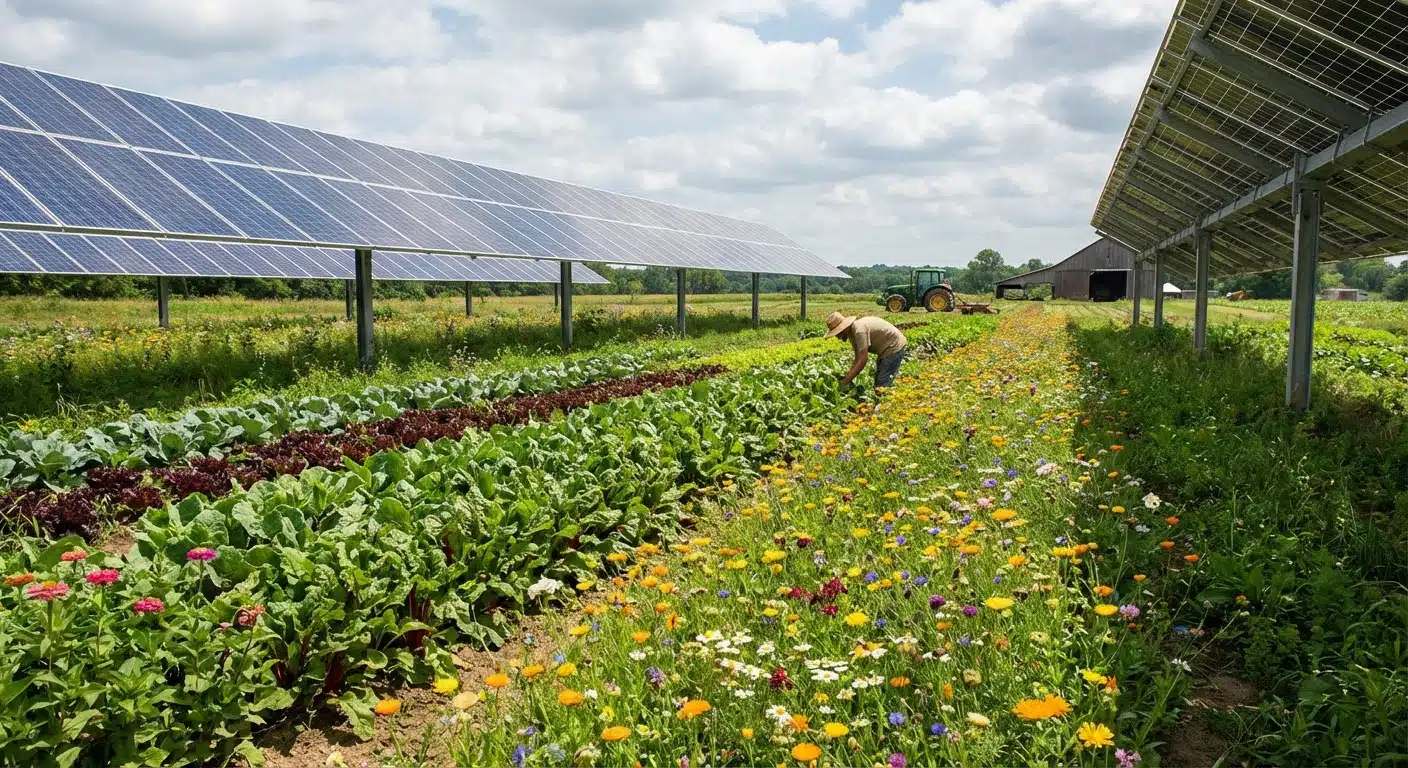
Agrivoltaics is the practice of combining agriculture and solar energy production on the same land. The U.S. Department of Energy defines agrivoltaics as the “co-location of agricultural activities and solar energy production,” including crops, grazing, and pollinator habitat beneath or between panels. It is not the replacement of farmland with solar. It does not involve scraping away all the topsoil, shutting down a family operation, or fencing off fields so a corporation can extract all of the land’s value and walk away. When designed properly, agrivoltaics keeps land in active agricultural use while adding energy production as a complementary layer rather than a competing one.
Agrivoltaics asks: How can this land produce more than one harvest at a time?
In practice, agrivoltaic systems are designed so that solar panels are elevated or spaced to allow light to filter beneath them. Crops, pollinator habitat, grazing animals, or specialty plants continue to grow between and under the panels. Farmers keep farming while the solar installation provides reliable energy and a long-term income stream.
When done well, agrivoltaics becomes multi-use land management rather than land conversion.
This works because solar panels do not simply block sunlight — they modulate it. Research shows agrivoltaic panels create cooler microclimates, reduce soil moisture loss, and moderate extreme heat, which can directly benefit crops. They create shade, shelter, and microclimates that many crops actually prefer. As someone who grows herbs and flowers, I can say this with confidence. Basil, thyme, mint, chamomile, calendula, lavender, lemon balm, echinacea, sacred sage, and dozens of culinary and medicinal plants thrive in partial shade, especially in the Southeast. Many leafy greens do as well. Heat-sensitive crops benefit from lower midday temperatures. Soil retains moisture longer. Evaporation is reduced. Pollinators find refuge and forage.
In addition to all of these plant benefits, agrivoltaics also offers farmers a steady income that doesn’t hinge on perfect weather or luck.

Agrivoltaics Through a Permaculture Lens
Permaculture design emphasizes stacking functions, building resilience, and creating systems where each element serves multiple purposes: food, habitat, soil health, water management, and long-term productivity. Agrivoltaics follows this same ecological logic. Solar panels create microclimates that reduce temperature extremes and evapotranspiration, improving water-use efficiency and lowering plant stress during heat events.
Rather than forcing landowners to choose between food and energy production, agrivoltaics allows both. This stacked land use aligns directly with regenerative and permaculture principles of producing multiple yields from a single footprint without exhausting the soil.
As with permaculture, thoughtful design matters. Panel height, spacing, orientation, crop selection, grazing practices, and native plantings must reflect local climate and land conditions. When done intentionally, agrivoltaics does not replace agriculture – it deepens it.
Why Farmers Are Paying Attention: Income Resilience
As the Winter Solstice comes and goes and the daylight returns, growers begin the quiet, necessary ritual of planning for the year ahead. This is the season of long lists and cold hands: turning compost piles, mending fences, cutting fallen trees into manageable logs, repairing irrigation lines you swore you fixed last summer. The greenhouse needs tidying, the seed tables need clearing, and your saved seeds need a proper germination test before you trust them with another season. Equipment is fixed and maintained. New seeds are ordered. A succession calendar is drafted. Beds are mapped for rotation. Animals are given extra care during the cold season, especially the moms and babies. All of it must be ready soon as the earth begins its slow inhale and the first stirrings of spring rise under the frost.
But for anyone who farms or homesteads, there’s another ritual not spoken of as fondly: preparing for failure. And failure will come.
Farmers and growers know it better than most. Squash bugs can level a bed in a single day. Leafminers can unravel a vine overnight. Deer can sense a tomato turning red from half a mile away and arrive just in time to ruin your hopes and your trellises. Hailstorms hit in June. Droughts creep in by July. Floods wash out entire beds in late August. Anyone who works the land understands this truth: you can do everything right and still watch a crop disappear.
For most small farmers, “resilience” is not an abstract policy term. It’s woven into the family fabric and the question that keeps us awake at night.
A single failed crop can break a season. A failed season can break a farm.
That’s the part most folks don’t see. It’s also the reason many farmers have become curious — sometimes quietly, sometimes urgently — about agrivoltaics.
Because what if there was a way to soften those losses? Not through federal disaster checks or crop insurance payouts, not through grants we may or may not qualify for, but through solar power.
Agrivoltaics introduces a steady, predictable income stream that can offset losses from pests, drought, or wildlife, stabilize revenue for small and mid-sized operations, and support practical needs like fencing, irrigation upgrades, equipment repairs, or new infrastructure. It can help keep land in agriculture instead of forcing sales to developers. It can enable younger farmers to take over aging family farms. And it offers a way to diversify income without requiring farmers to abandon what they already do well.
For rural communities across the Southeast, where land values are rising and agricultural margins are shrinking, this additional income matters. This is how working lands stay working.
There is also a larger, uncomfortable reality that must be named. Major power utilities are pushing for new methane gas plants primarily due to speculative new data center demand. Agrivoltaics offers an alternative path — one that turns rural land into an energy asset for rural landowners, not just for data-center developers and power plants.

Agrivoltaics Is Proven — and Growing Fast
Agrivoltaics is no longer theoretical. It is already working across the country.
In Colorado, growers have produced thousands of pounds of vegetables in agrivoltaic systems despite shorter growing seasons. Massachusetts has built one of the most developed state-level ecosystems for dual-use solar on farms in the U.S., supported by land-grant research and extension programs tracking farm-compatible solar practices and outcomes. Maine is testing agrivoltaics with blueberry growers to protect heat-sensitive crops. Arizona, Oregon, New York, and Vermont are all demonstrating yield improvements for specific crops. Solar grazing under arrays has become one of the fastest-growing agricultural trends in the country, allowing livestock to graze under panels rather than using gas-powered mowing equipment, creating new farm income where none previously existed.
Globally, research shows agrivoltaics can improve yields for peppers, tomatoes, berries, melons, leafy greens, herbs, nursery crops, and cut flowers. These systems also increase pollinator habitat, restore soil health, and reduce heat-island effects.
The science is clear: agriculture and solar can be stronger together than they are apart.
A Final Thought From the Meadow
Agrivoltaics isn’t a departure from the management we give our farms and gardens as ecosystems. It’s a continuation of the same philosophy that guides every compost pile, every cover crop, every carefully placed trellis: work with the land, and the land will work with you. Whether we’re harvesting chamomile at dusk, tying lavender bundles to dry in the rafters, or marking the seasons by the rise and fall of the compost pile, the land remains both our livelihood and our teacher.
Agrivoltaics does not replace that relationship. It deepens it.
It gives the land a second job.
It gives the farmer a safety net.
And it gives rural communities a way to stay rural without sacrificing opportunity.
As we turn our compost, mend our fences, and prepare for the season ahead, it is worth asking:
What else might our land be ready to grow?
And what might we grow together if we let the sun do more than one job?