

Solar and agriculture have long been cast as competitors for land. But a growing number of farmers, grazers, and land conservation advocates across the country are proving that the two can coexist. In fact, putting solar and agriculture side by side, or even one on top of the other, can be one of the most powerful tools available to help keep American farms alive.
Solar Protects Multi-Generation Farmland in Massachusetts
Joe Czajkowski is a third-generation farmer in the town of Hadley, Massachusetts. Czajkowski Farm provides produce for local restaurants, universities, schools, and even major retailers like Trader Joe’s. He first developed an interest in agrivoltaics after installing solar panels on the roof of his carrot packing facility. With the additional savings from the panels, Czajkowski transformed the facility from a building used only six months a year into a year-round financial benefit.
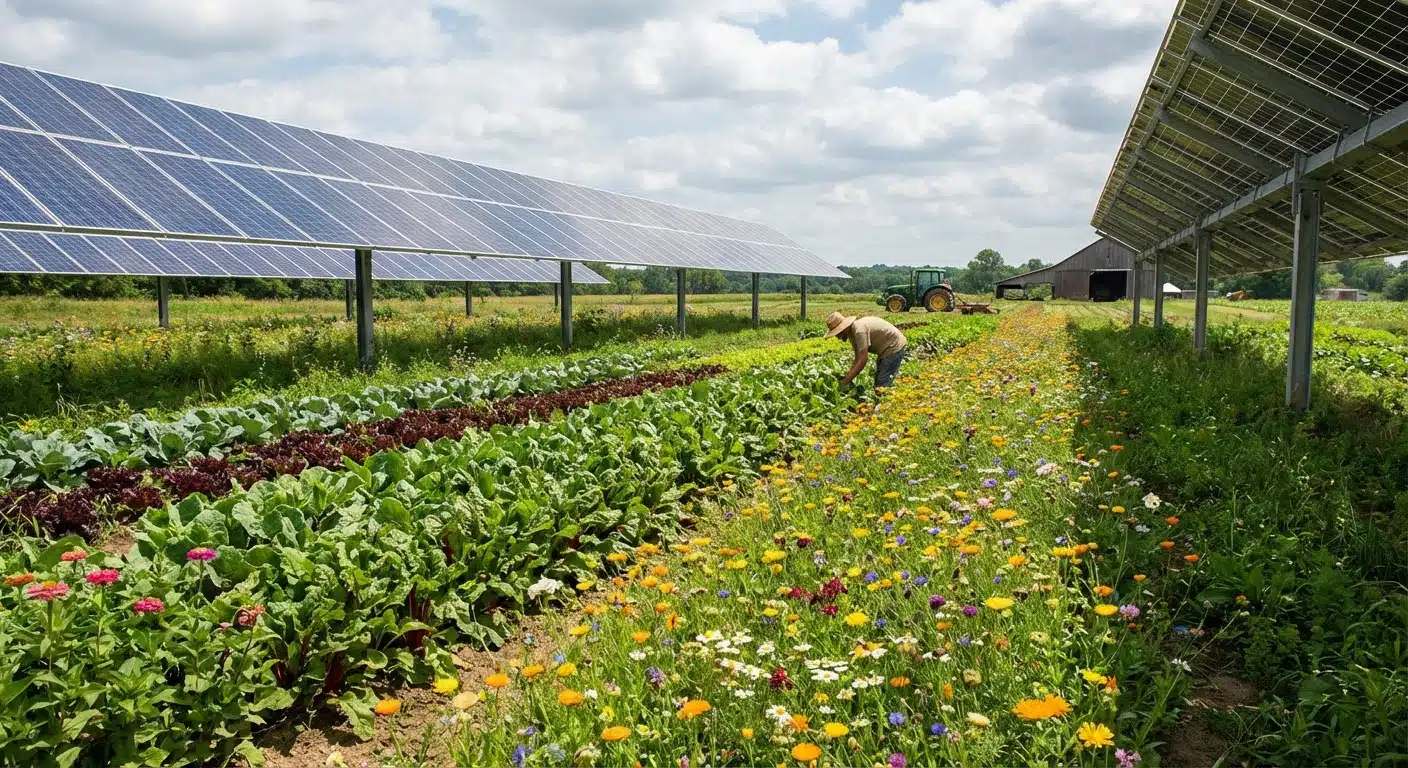
Now, Czajkowski says the 445 kilowatts of solar that rise above his broccoli field have not changed the way he tends to and harvests vegetables, but they have changed his life. Ever since the agrivoltaics array designed by local solar developer Hyperion Systems became operational in 2024, Joe has enjoyed cost savings and additional income from leasing his land to the developer.
These solar energy projects have been a worthwhile investment for Czajkowski. Now he is working with Hyperion to add solar to two more fields on the farm. The pressure is on this year to begin construction at both sites, as Czajkowski plans to take advantage of the federal Investment Tax Credit before it is phased out completely for solar projects. And in Massachusetts, he can take advantage of an additional incentive program called SMART. Through the Solar Massachusetts Renewable Target program, solar system owners receive monthly payments for the electricity their solar panels produce. Agrivoltaics systems can qualify for an additional incentive under the program.
Czajkowski recognizes that issues such as land constraints and nearby transmission capacity are determining factors in what is feasible for solar installations, but he advises his neighbors and other farmers to go for it. He believes agrivoltaics is a solution that far outweighs the alternatives — power imported from far away, and farmers selling their land to real estate developers.
“I would rather see the power come from your neighboring farmer. The money stays right in the neighborhood. And that’s a good thing, too.” – Joe Czajkowski
What Agrivoltaics Can Mean For a Farm’s Bottom Line
Across the country, farms are operating on razor-thin margins. Czajkowski puts it plainly: “A lot of farms, if you follow the news, are working with negative margins right now on crops, and they have been for about four years.”
For those farmers, the rental income from a solar lease can be the difference between staying afloat and selling. According to Czajkowski, the per-acre returns from electricity generation are eight to ten times what a corn field might gross.
“We get the rent, which is, you know, sizable per acre. On a field of corn, you’re lucky to gross $750 an acre, maybe $1000 at the most, and from the electricity, you’re going to get eight to ten times that. So it’s pretty wonderful.” – Joe Czajkowski
The financial picture isn’t without complications. Installing solar panels is expensive, and without the now-paused REAP grants that provide funding to farmers and rural business owners for renewable energy projects and energy efficiency upgrades, the math doesn’t always work out. Particularly for older farmers wary of taking on debt, solar might seem unattainable. The federal Investment Tax Credit is still available, but timing is crucial now that the federal government has accelerated the incentive’s phaseout: some incentives may change after 2027, which is why farmers like Czajkowski are racing to get new projects in the ground now.
In Virginia, Communities Work Together To Get Projects Up and Running
For agricultural communities in Virginia, the Piedmont Environmental Council (PEC) is leading the way in increasing access to agrivoltaics. An environmental group dedicated to building more sustainable communities in the Virginia Piedmont region, PEC completed Virginia’s first crop-based agrivoltaics project in the fall of 2025. The organization acquired a 170-acre plot of land originally slated to become a shopping center and turned it into Roundabout Meadows Community Farm. With the help of three full-time staff members and many volunteers, the farm produces over 50,000 pounds of produce annually, and donates almost all of it to food-insecure communities and local food pantries.
Giving back to the community is central to PEC’s work on the farm. The process of adding solar was no different. Their agrivoltaics pilot project, which sits on a quarter acre, was designed to reframe the conversation around renewable energy and agriculture in the state. By co-locating solar and vegetable crops, PEC has the opportunity to show rather than tell, bridging a gap and strengthening connections with agricultural community members and local government officials.
“Agriculture is really important in Virginia. We need to make sure that we develop these projects in a way that listens to that community and incorporates their concerns, and they have to be at the table.” – Ashish Kapoor, the Senior Energy and Climate Advisor at The Piedmont Environmental Council
Originally, PEC was looking to add solar to the roof of a barn on the property. Research for that project led Kapoor to the National Laboratory of the Rockies’ Energy to Communities program, which provided a technical assistance grant that helped PEC design its agrivoltaics system. The program guided key decisions, such as spacing the panels to allow light penetration, positioning raised beds and in-ground planting to test different growing configurations, and adding battery backup so the farm can operate independently during power outages.
“It’s not like you have to do this because it’s Richmond’s agenda or Washington’s agenda,” Kapoor explained. “This is a way for you to save money on your electric bill, keep agricultural land in production, and have energy backup in the event of an outage.”
That energy independence framing resonates with agricultural communities in ways that other, climate-focused messaging hasn’t.
PEC’s installation was completed with Tiger Solar, a Virginia installer that gained new expertise in agrivoltaics through the project. In its first partial growing season, the farm has already produced kale, lettuce, beets, and turnips under and around the panels, with promising early results. A full growing season’s worth of data is still to come, but PEC is already planning regular public tours to let farmers, local officials, and curious neighbors learn about agrivoltaics firsthand.
Agrivoltaics is Creating Opportunities for New Farmers in Kentucky
Katie and Brad Carothers opened their first farm in Ohio with zero experience: neither of them came from a farming family or grew up on large tracts of land. At first, the thought of making a full-time living from farming cut flowers and sheep felt unbelievable — until a flyer from a neighbor appeared in their mailbox.
“I was just flipping through the mail, as you do, and came across a flyer,” Katie said. It was from a neighborhood community group, warning residents about an incoming solar development. Rather than alarm, Katie saw an opportunity. She turned to her husband and said, “I wonder if we could graze it.”
Katie found the solar farm developer through a well-connected neighbor, and the Carothers’ land management business, New Slate Land Management, was soon hired as a consultant on the project. From there, an opportunity emerged to move to Kentucky and begin grazing at an already operational site for Silicon Ranch, a major solar developer with whom the Carothers had already built a relationship through their seedstock flock. The business grew quickly, largely because of a partnership with Dr. Camren Maierle, a PhD sheep scientist from Ohio with generations of farming experience. Now, the Carothers graze sheep on roughly 1,500 acres of solar sites in Kentucky, working full-time in a business they built from scratch.
“Find a partner that addresses where you’re weak,” Katie advises. “A lot of times in agriculture, everyone seems to be on their own island. Working together is a little foreign. But not being afraid to do it is really important, especially when you’re trying to build something fast.”
For the Carothers, the solar grazing model has unlocked what conventional sheep farming couldn’t: access to land. Without owning any acreage or inheriting a farm, they are now paid to manage more than 1,000 acres by grazing their sheep on Silicon Ranch. Local land management businesses also benefit from the arrangement, and this arrangement also creates opportunities to employ local mowers and buy local equipment, feed, and livestock.
What Happens Under the Panels? Crops, Sheep, and the Science of Dual Use
One of the most common concerns raised about agrivoltaics is yield. If the panels shade the crops, won’t the crops suffer? The answer, according to both the data and the farmers living it, is nuanced — and encouraging.
Katie Carothers found that the microclimate beneath the solar panels sustains cool-season grasses such as orchardgrass, clover, and fescue well into the summer, even as the same species burn out on open ground. The shade under the panels retains moisture and moderates temperature. For sheep bred to thrive in these environments, it’s a natural fit that extends the grazing season.
“It almost feels too perfect sometimes. It’s like it was made for sheep under here.” – Katie Carothers, New Slate Land Management
Joe Czajkowski reports about 80 percent of the yield he would get in an open field, with the only real reduction coming in the spots where posts are planted in the ground. Between those posts, the yield is comparable to open-field production. In fact, last summer— when Massachusetts saw 27 days over 90 degrees — the panels’ shade actually helped.
“A plant has to work harder when it’s really hot,” Czajkowski explained, “to transpire water from the roots through the vascular system into the leaves to protect them from burning up.”
Research from Europe has reinforced this idea. In France, growers have reportedly seen higher berry and fruit yields under panels than in open fields. Czajkowski has also experimented with broccoli, sweet corn, and cilantro, all of which performed well. He’s eyeing blueberries, asparagus, and even mushroom logs as future possibilities for the spaces between the posts — crops that welcome shade rather than just tolerating it.
Policy & Public Opinion Challenges and Creative Solutions
In Virginia, PEC has taken a legislative approach to advancing agrivoltaics as a win-win solution to some of the problems plaguing farmers. Working alongside the Virginia Farm Bureau, PEC helped draft a bill to formally define agrivoltaics in state law and to establish a stakeholder working group comprising farmers, solar developers, utilities, and local officials. The Virginia General Assembly passed the bill in early March. The bill received a notable endorsement from Virginia Governor Abigail Spanberger, who has identified it as a priority for her administration. The working group will spend the year producing a report for the General Assembly that can form the foundation for future incentives and permitting reforms.
Kapoor is careful not to overstate the power of policy alone. The harder work, he says, is building trust and understanding in the community.
“A lot of times with renewable energy development, that conversation doesn’t happen except at the planning commission meeting and the Board of Supervisors, and then it’s contentious,” he said. “We need to set the table in a more proactive and productive way.”
Czajkowski has encountered his fair share of resistance, particularly from neighbors concerned about the visual impact of solar panels on the landscape. Over time, they mellowed. Czajkowski points to Massachusetts’ Chapter 40A protections, which bar unreasonable restrictions on solar projects, as an example of state law that gives farmers real standing when neighbors or local officials push back. He’d like to see similar protections elsewhere, along with more research on optimal crop selection and greater recognition of landowners’ rights.
He also points to the economic justification: the revenue from agrivoltaics stays local. A farmer who spends solar rental income at local stores and supports local schools is a neighbor, not a distant utility or foreign oil producer.
“I’d like to see a little bit more open-mindedness on this,” Czajkowski said.
Katie Carothers has found that being visibly present as an agricultural producer tends to defuse tension quickly.
“If someone doesn’t already have a very passionate opinion about whether solar is good or bad, and I tell them what I’m doing, it usually brings them around,” she said. “Here’s the truth: I work on the site all the time. I’ve never been poisoned or electrocuted.”
The Road Ahead: A Vision for Agrivoltaics
Ashish Kapoor sees the future of agrivoltaics in mathematical terms. Virginia has 40,000 farms, averaging under 200 acres each. The state needs to more than double its electric grid in the next 15 years. If even five percent of those farms put a megawatt of solar on their land, the contribution to the grid would be enormous — reducing the pressure on pristine agricultural land and forests from large-scale utility projects.
“You put a megawatt on each farm, that’s 40 gigawatts,” Kapoor said. “Obviously unrealistic, but if you took a few percentage points of that, it’s a viable solution. It’s not just some utopian thing. It’s: how do we get more of it?”
Agrivoltaics might not save every farm or solve every energy problem. But in the fields of Hadley, Massachusetts, on the hillsides of Loudoun County, Virginia, and on a Kentucky solar site where sheep graze in the shade of a summer that would otherwise scorch the pasture, something real is growing: A future powered by the sun, tended by farmers, and built on the idea that land can do more than one thing at a time.

Ready to Learn More? Check Out Agrivoltaics 101
On Thursday, March 12, SACE hosted “Agrivoltaics 101,” a webinar exploring how solar energy and agriculture can work together to support farmers, protect working lands, and advance clean energy goals across the Southeast. Speakers Greg Plotkin, Senior Manager for Smart Solar Outreach and Engagement at American Farmland Trust (AFT), and Mike Storch, Associate Director of Sustainability and Community Impact at Cypress Creek Renewables, shared practical insights and real-world examples of this growing practice.