


Every Monday evening for ten weeks, Jason Watters drove two and a half hours from Birmingham, Alabama, to Atlanta, ran a two-hour career training session at Vicars Community Center, then turned around and drove home. He did it rain or shine, week after week, because he wanted the participants to see his commitment.
“They saw that Mr. Jason is coming two and a half hours away every Monday,” says Watters, Workforce Development Manager at Southern Company. “We owe it to ourselves to show up.”
That consistency and the philosophy behind it are the heart of what Watters calls one of the better workforce initiatives he has been part of. The pre-employment training program, launched as part of the broader Westside Resilience Corridor effort, brought together Georgia Power, Southern Company, Groundswell, the City of Atlanta, and Vicars Community Center to offer residents of Atlanta’s historically underserved westside a pathway into energy sector careers. What it delivered was something larger than any of those partners initially anticipated.
Beginning With the End in Mind
The program grew out of conversations that were originally much more modest in scope. Georgia Power’s Community Resilience Group had been meeting with corridor partners to discuss how infrastructure investment alone could not deliver equitable outcomes for westside neighborhoods. Someone asked why the workforce training that Georgia Power already ran through community college partnerships couldn’t be brought directly to the community.
“Our answer was, well, why not,” Watters recalls.
Within two or three email exchanges, a planning process was underway. The goal, as Watters put it, was to begin with the end in mind: identify jobs that mattered — both to Georgia Power and to the broader energy industry — and work backwards to identify the skills people would need to compete for them. The target population was residents who were underserved, underrepresented, or underemployed.
The curriculum that emerged covered electrical and energy system fundamentals, construction readiness and tool proficiency, solar and distributed energy basics, and soft skills, which Watters considers most essential. Every week, regardless of which technical module was on the agenda, the program wove in coaching on communication, workplace readiness, resume writing, elevator pitches, and interview prep.
“That last one was probably the most important,” he says. The cohort turned out to be far more diverse than anyone had planned for: participants ranged in age from 21 to considerably older, and included college graduates, people working toward their GED, mothers returning to the workforce after years away, and people new to the city altogether.
“Regardless of what their interests were, we wanted to develop something where everybody left better to compete for whatever roles they have an interest in,” Watters says.
Removing Barriers Before They Become Reasons to Leave
The program recruited from a wide network: the Urban League of Greater Atlanta, Black Men Lab, a radio partnership with WAOK, and the four West Side corridor churches, whose pastors advertised the opportunity directly to their congregations. Over two weeks, the outreach generated more than 90 applicants. All were invited to an orientation at Vicars Community Center. The event was standing-room only.
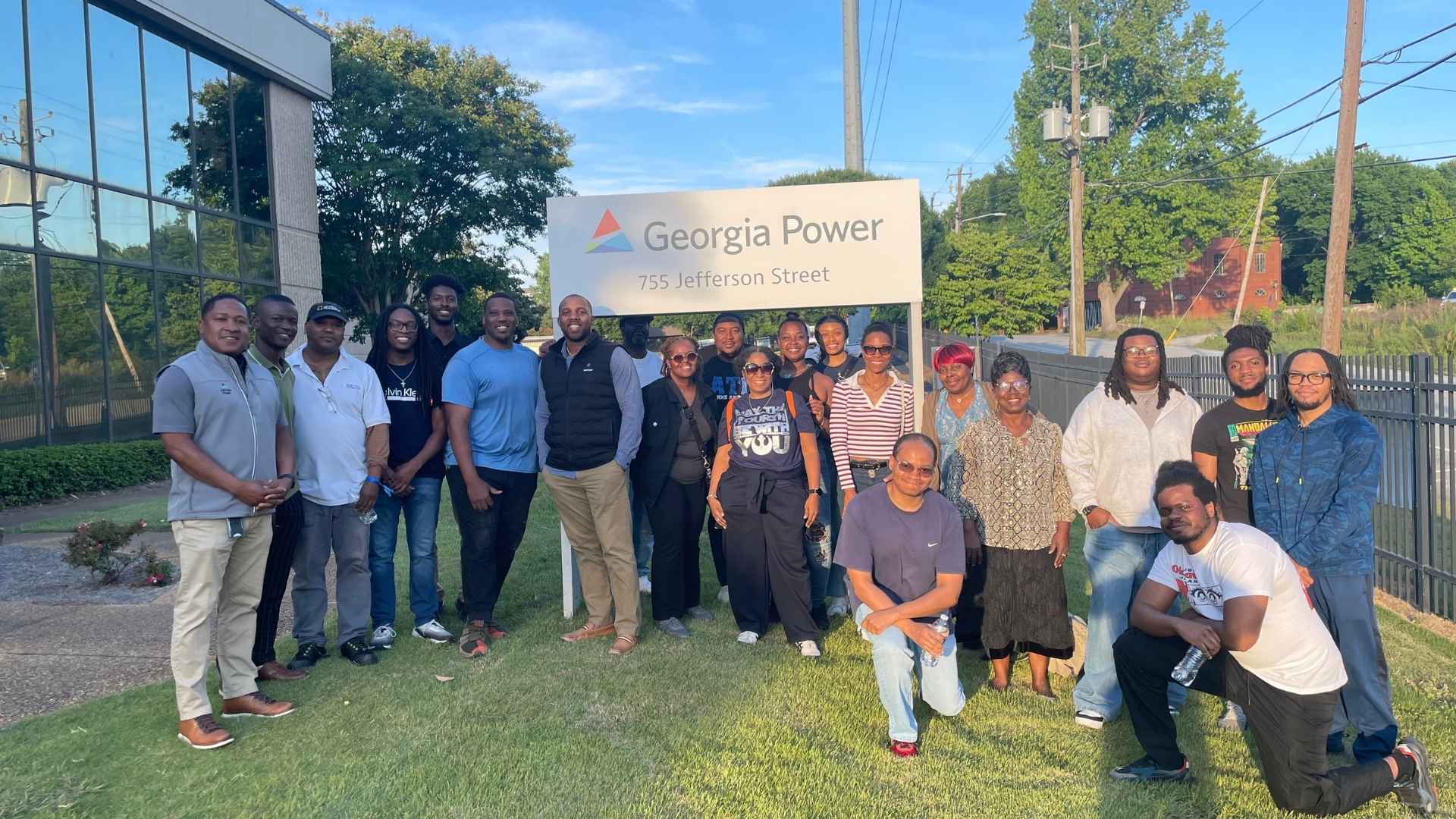
The cohort was screened down to 22 individuals. Over ten weeks, 20 completed the program — and the two who left did so for reasons unrelated to the program itself, one of whom had to relocate to care for a family member.
Watters attributes that retention rate largely to the wraparound support built into the program’s design. Participants received hot meals at each session and food boxes to take home. Transportation was covered through rideshare funding. Childcare was available. Stipends were distributed periodically. None of this was framed as charity — the program was intentional about not calling out individuals who needed support, instead communicating at the outset that resources were available for anyone who needed them.
“Those three components, more so than the curriculum and just the engagement we have with students, really served us well,” Watters says.
The support extended well beyond the classroom. Watters describes one participant — recently released from a correctional facility and living in transitional housing — who maintained perfect attendance throughout the program. When he secured full-time employment, transitional housing immediately moved him out, leaving him without stable housing just as he was getting back on his feet. The team scrambled to coordinate temporary living arrangements.
“We couldn’t care less about the program,” Watters says. “We wanted to make sure that this gentleman was good, because he worked so hard to get himself back on his feet.” He is now working as an equipment operator for the City of Atlanta.
Placement, Not Placement Rate
The program’s first job placement came after week one — before the curriculum had even fully begun. A participant expressed interest in supply chain; Watters’s team connected him with employers in the southwest Atlanta area. By that Thursday he had an interview. By Friday he had a job. He kept coming to the sessions anyway, rolling in each week with three friends who were also in the cohort.
That early success sparked what Watters calls the “praise report”: a standing segment at the start of each Monday session in which participants shared job offers, interviews, assessments passed, or continuing education milestones.
“It made people want to have something to celebrate,” he says. “It really motivated everybody.”
About a month after graduation, 16 of the 20 graduates were either employed or enrolled in formal continuing education programs in fields spanning supply chain, human resources, customer service, skilled trades, construction, energy efficiency, and even audio engineering. An engineering graduate who had no idea what to do with his degree is now working as an energy assessor for a utility services firm headquartered two blocks from where he grew up.
“How do you aspire to a job that you didn’t know existed?” Watters asks.
That question captures a huge lesson learned from the program: job awareness is as much a barrier as job readiness.
“Sometimes we take for granted that people are aware of the opportunities that we have, because they’re on a website,” Watters says. A posting on a careers page does not reach the same people that a pastor does, or that a neighbor in a utility truck does.
The program addressed this gap through an “employer spotlight” segment built into each weekly session — a 20-minute window for a hiring manager or small business CEO to talk about their work directly with participants. The effect was practical: a participant might leave that session knowing not just that a job existed, but also that someone at the company could vouch for them.
What Georgia Power Gets Out of It
Watters is candid about the business case. The program was not charity, and framing it as such would undersell what it actually accomplished. The graduates, even if they are not Georgia Power employees, are working in fields directly transferable to the company’s workforce needs — HR, supply chain, construction, energy efficiency, skilled trades. They are also, by working and earning, more likely to be stable utility customers. And they are, in Watters’s framing, boots on the ground: people who go home every evening in the logo shirt of wherever they work, as organic advocates for what a career in this industry can look like.
“The quickest way to economic development is economic empowerment,” he says. “The more people that you have working, the more likelihood you have of being able to pay your Georgia Power bill on time — but not only that, we want strong communities.”
There is also a longer-term talent pipeline logic. An HR specialist now working at Georgia Tech is a natural future candidate for an HR role at Georgia Power. A construction worker placing underground infrastructure is building skills directly applicable to utility work. None of these are guaranteed outcomes, but they are probable ones — and they cost far less to develop than recruiting from scratch.
What Watters pushes back against is the framing of workforce development as a box to check. Georgia Power has been present in Atlanta neighborhoods through K-through-12 career exposure days, community college sponsorships, summer internship programs, and community resilience education — work that predates and outlasts this particular cohort.
“You have to do the work, and you have to be consistent with doing the work,” he says. “You can never really unmeet someone.” Watters reports still hearing regularly from graduates, even receiving a text on Father’s Day or a call to share news of a new apartment.
What Comes Next
Both Watters and West Hunter Baptist Church’s Rev. Cedrick Von Jackson have expressed interest in a second cohort as soon as logistics allow. In the interim, Watters is hoping to organize a hiring fair at Vicars Community Center — not a job fair, he is careful to say, but a hiring fair, with actual employer partners ready to make connections with the roughly 70 applicants who expressed interest but were not selected for the first cohort.
“We now have a product that those employer partners recognize and can trust,” he says.
For a second full training cohort, Watters says he would design things somewhat differently: recruiting more specifically to particular trades or job families, then building the curriculum around those targets rather than trying to serve everyone at once.
“We ended up doing what you never do for a pilot,” he says. “We didn’t make it easy for ourselves. We had a diverse group of people with many different interests, yet we found a way for everybody to get something.”
That improvisational generosity — the willingness to bring in an extra child for an evening, to record a session for someone who couldn’t make it, to stay until everyone had a safe way home — is what Watters describes as the program’s real operating principle. The curriculum was a framework. The relationships were the work.
“Relationships don’t expire,” he told participants every week. “Once you meet someone, you can never really unmeet them.”
This article is part of a series on the Westside Resilience Corridor, a coalition of Atlanta faith institutions, community organizations, and public and private partners working to build energy resilience, economic opportunity, and community well-being on Atlanta’s westside. The pre-employment training program was developed in partnership with Georgia Power, Southern Company Gas, Groundswell, the City of Atlanta, and Vicars Community Center.


