

Rural America has always been resilient — not because of centralized systems, but because of adaptability, cooperation, and a deep knowledge of land and seasons. Yet today, rural communities are being squeezed from every direction.
Farmland is being consumed by sprawl. At the same time, many young families and first-time farmers are trying to return to the land, only to find it increasingly unaffordable and harder to access. Crop markets are volatile, and shifting trade policies add financial uncertainty. Meanwhile, rising electricity demand, including demand from data centers and large commercial and industrial customers, is prompting new energy infrastructure in rural areas, raising questions about land use and local decision-making. Rural solar development, too, has created tension. When some residents see thousands of panels replace open fields, the reaction is often visceral. To them, it can feel like an erasure of land, heritage, and identity. And truthfully, we understand that reaction. But that’s only a small part of the story.
Solar and Rural Land
Rural solar is a key piece of conserving rural and agricultural land. As American Farmland Trust states, “Some see a conflict between growing food and producing renewable energy. But America needs both — clean energy and productive, resilient, and viable farms and ranches.”
While some people view solar as a threat to farmland, many landowners understand this is an opportunity to keep their farm profitable, diversify income, and preserve their land for future generations.
When a solar facility is proposed in a local community, it’s easy to focus only on what’s visible – panels in open fields. What is often overlooked is that the solar facility can help conserve rural land overall and reduce the need for land-intensive fuel extraction and destructive energy fuel infrastructure. Coal, gas, oil, and uranium require vast swaths of rural landscape to be mined, drilled, extracted, transported, and ultimately burned, often leaving behind polluted land, air, and water, and harming communities. Solar development, on the other hand, can easily coexist with and strengthen local communities and create safe, pollution-free energy.
Residential Sprawl Is Behind the Largest Loss of Farmland
It’s easy to overlook what’s actually driving the largest loss of farmland. In the Southeast, the primary source of agricultural land conversion isn’t solar — it’s residential sprawl. Between 2001 and 2016, conversion to low-density residential uses represented 46-78% of agricultural land conversion in the region. In North Carolina, as of 2022, utility-scale solar occupied less than one-half of one percent of agricultural land, compared to more than 10% of ag land converted to subdivisions, residential parcels, associated infrastructure, and other more developed uses. Converting farmland to residential and commercial development fragments and permanently alters agricultural landscapes. Roads, utilities, and permanent structures make a return to farming nearly impossible.
None of this negates the fact that, as energy demand grows and the transition to cleaner power accelerates, rural land will increasingly be part of that conversation. But the conflict isn’t solar itself. It’s how it’s deployed. What if solar didn’t have to mean replacing farmland at all? What if it could mean more — more productivity, more biodiversity, more stability, more income for those who’ve stewarded this land for generations?
Using an agrivoltaics strategy, landowners are able to generate electricity while continuing to grow the crops we all depend on — and secure steady, predictable income to supplement farm revenue, strengthening farm viability.
Farming the Sun, Protecting the Soil
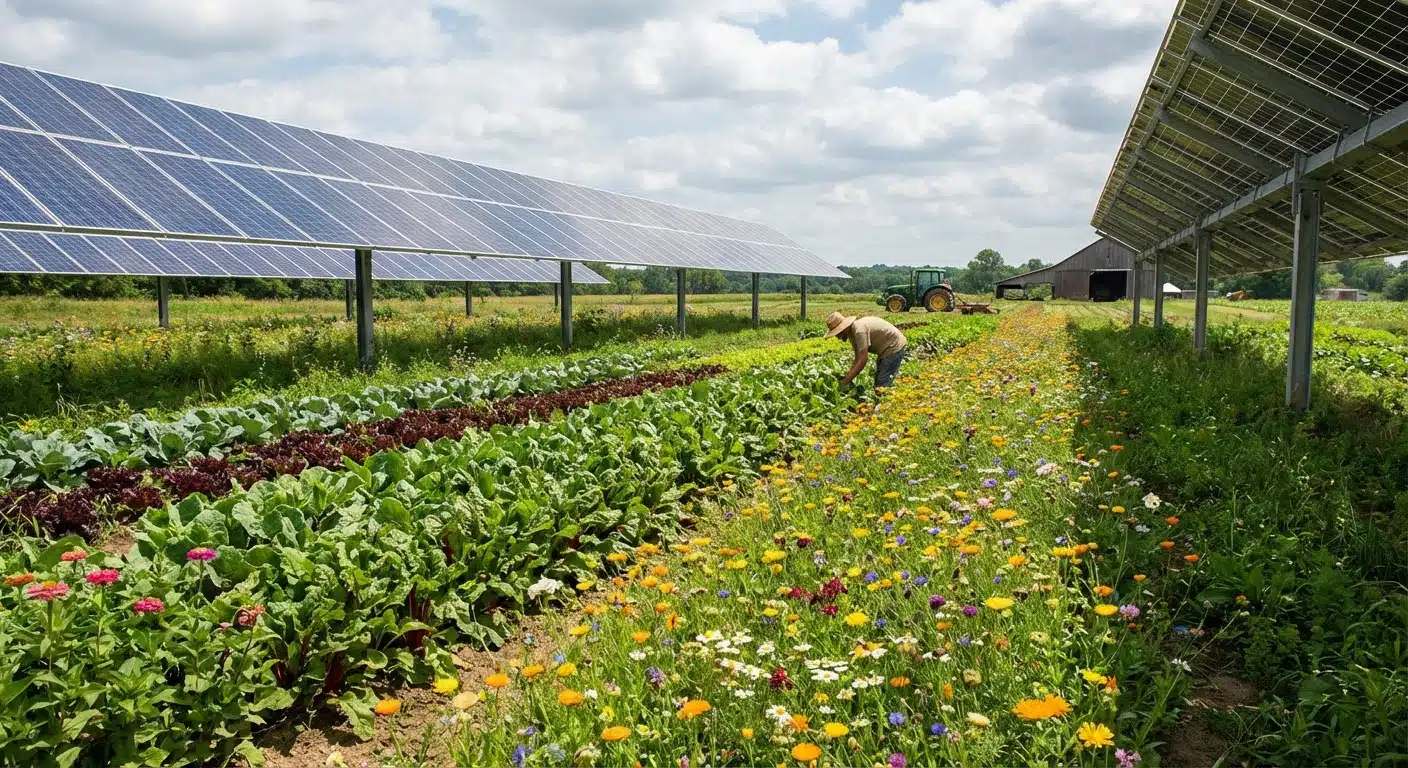
Agrivoltaics offers an alternative to conventional utility-scale energy projects. By integrating solar generation with active agriculture, agrivoltaics allows land to remain productive in more ways than one. Crops, pollinators, and livestock can thrive beneath and beside elevated panels. Native vegetation stabilizes soil and improves water retention. Farmers gain steady, long-term income that helps buffer against volatile markets and increasingly unpredictable weather patterns. And, just as importantly, energy generated where it’s used strengthens rural grids instead of concentrating power in distant facilities. You can read more about agrivoltaics — what it is, how it can be employed, and its benefits — in our recent article, “Agrivoltaics: Growing Food, Growing Power, and Growing Possibility in the Southeast.”
Integrating solar and agriculture isn’t an experimental theory. Across the world, agrivoltaics is already delivering results: vineyards in France, berry farms in Canada, vegetable operations in Colorado, and grazing systems throughout the U.S. These projects are proving that food production, conservation, and clean energy are not competing interests. They are complementary ones.
Clearing the Fog: Solar Myths That Don’t Hold Up
Community opposition to utility-scale solar has grown in recent years. Much of that resistance is rooted in understandable concerns about land use, but some of the most common claims don’t hold up under closer examination.
“Solar Takes Up Farmland”
In reality, agrivoltaic systems are designed to conserve farmland by keeping it economically viable. Dual-use systems help prevent land sales to developers by giving farmers an additional revenue stream that supports continued production.
Research shows that certain crops can benefit from the moderated microclimate created by elevated panels, which can reduce heat stress and lessen soil moisture loss. Yield improvements have been demonstrated in select crops, including strawberries, basil, broccoli, celery, corn, grapes, kale, lettuce, pasture grass, peppers, potatoes, and tomatoes.
Unlike residential or commercial development, conventional utility-scale solar typically involves only a temporary change in land use rather than a permanent conversion. With proper decommissioning and restoration, the land can return to agricultural production at the end of a project’s life, and guarantees are often baked into local or state regulations to ensure proper decommissioning can occur at the end of a solar energy facility’s life.
“Solar Ruins Soil”
Solar panels don’t contaminate soil. With native groundcover, pollinator habitats, rotational grazing, and thoughtful management, soil health often improves, erosion is reduced, moisture is retained, and chemical inputs decline.
“Solar is Unreliable”
Solar energy is a dependable resource, especially when it’s properly integrated into the grid. While solar output varies with time of day and weather conditions, those patterns are well understood and incorporated into grid planning and forecasting.
Reliability isn’t determined by a single resource operating in isolation. It’s achieved through thoughtful system design — by combining distributed generation, battery storage, transmission, and demand management. When paired with battery storage, solar can provide firm capacity, support peak electricity demands, and strengthen grid resilience.
Distributed solar and storage have kept homes, businesses, and critical facilities operating during extreme weather events and grid disruptions, including situations where centralized fossil infrastructure failed.
The question isn’t whether solar can contribute to reliability. It’s whether we are designing the system to use it effectively.
The Southeast Should Be Leading in Agrivoltaics
By every measurable standard, the Southeast is primed for agrivoltaics. We have long growing seasons, abundant sunlight, millions of acres of working farmlands, and diverse specialty crops. Rural communities are seeking stability, not speculation. Local power companies are deeply embedded in the places they serve. Agrivoltaic innovation is accelerating elsewhere in spades, including the cold, cloudy, frigid Northeast.
In Maine, blueberry growers are testing how their fields perform beneath solar panels. In Ontario, Canada, strawberries are growing at commercial solar farms. Massachusetts has embedded agrivoltaics directly into its landscape – grazing sheep in some fields, cultivating vegetables and wildflowers in others, and proving that dual-use systems can enhance, not replace, agricultural land. Even Colorado, with harsher winters and a fraction of our growing season, has managed to produce over 25,000 pounds of fruit and vegetables in agrivoltaic systems.
In the Southeast, we are starting to see leadership emerge. North Carolina State University recently launched a dedicated Agrivoltaics Training Site, Silicon Ranch has expanded Regenerative Energy and agrivoltaics projects, and farms such as Montgomery Sheep Farm in North Carolina are integrating livestock and solar successfully. Projects like Florida Power & Light’s Blackwater River Solar Energy Center and Onward Energy’s Twiggs County solar farm in Georgia are incorporating grazing and land stewardship into solar development. These early efforts matter. They demonstrate that agrivoltaics works here. But they remain the exception rather than the norm.
The regions leading at scale are doing so because they have aligned policy, incentives, and institutional commitment. In the Southeast, despite ideal conditions and promising proof-of-concept projects, progress remains uneven. Too often, the debate is still framed around whether solar belongs on farmland at all, rather than how to deploy it in ways that strengthen both agriculture and energy systems. Imagine a world where all our utility companies choose to see farmers as partners instead of mere customers.
Rethinking Resilience
Building an energy system for the 21st century requires preparing for more frequent extreme weather, transmission disruptions, and localized outages. Geographic diversity in generation and thoughtful backup solutions are essential components of that effort. Of course, backup generators are nothing new, but when the Tennessee Valley Authority (TVA) adopted its new Resilience 360° program, which incentivizes on-site gas power generation for large commercial and industrial facilities, SACE published an article outlining concerns that the program’s design prioritized on-site fossil generation over more community-centered resilience strategies. We also believe that distributed solar, like agrivoltaics in rural communities, paired with energy storage, is a key component of how TVA and utility companies across the Southeast could provide energy resilience in a way that brings many more benefits to the communities they serve.
When TVA launched its Resilience 360° program, it promised innovation, reliability, and preparedness for an uncertain future. But for all the talk of resilience, the program reveals a deeper flaw in how resilience is being defined – and who it’s designed to serve.
TVA’s version of resilience starts behind industrial fences with incentives supporting projects up to 25 megawatts. While the program allows methane gas or battery storage, this structure could result in more gas-fired systems being installed at factories, data centers, and large industrial sites. When resilience investments rely on new gas turbines, they reinforce fossil fuel dependence and increase local air pollution. The result is resilience focused on industrial load rather than on communities, land, or food systems.
That same 25-megawatt model — those same incentive dollars and institutional focus — could look very different if applied across working landscapes.
Imagine directing that scale of distributed investment toward farms across the Tennessee Valley. Thousands of farms already have the acreage, grid access, and stewardship capacity to host generation. Through agrivoltaics, they could produce food and power side by side, strengthening rural resilience, preserving farmland and green space, and expanding the benefits of distributed energy beyond industrial fences.
A 25-MW agrivoltaic installation typically spans 120-150 acres, depending on the design. Crucially, those acres are not blanketed in panels, but are incorporated into a working landscape. Wide spacing, elevated arrays, open corridors, and working lanes preserve agricultural function and operation. Much of the land remains in active production — cropping, grazing, or habitat restoration. The result is a landscape that still looks and functions like farmland, with an added layer of clean energy production.
Where a single farm may not be able to host an entire 25-MW agrivoltaic installation, the range of scale already contemplated under Resilience 360° makes smaller projects entirely feasible. The program allows projects from 100 kilowatts to up to 25 megawatts, meaning a 1-5 MW agrivoltaic system, requiring perhaps 5 to 20 acres depending on design, could be viable for many working farms. For larger capacity, cooperative models or farm clusters could aggregate generation across multiple properties. Multiply that across even a small fraction of the Valley’s working farms, and you create a resilient, interconnected network of clean energy sites woven directly into the agricultural fabric of the region.
That’s the essence of agrivoltaics: same scale, different values, radically different outcomes. A system where resilience isn’t bought by burning more gas, but built by sharing the sun.
Beauty, Balance, and Belonging
Resilience doesn’t have to look industrial to be effective. Agrivoltaic landscapes are alive. Panels above wildflowers. Bees are working clover, vetch, and echinacea. Sheep resting in the shade. Tomatoes and peppers are growing well into the fall. These are places that still feel rural, rooted, connected, and still belong to the people who care for them.
Agrivoltaics puts rural communities in a leadership position in the clean energy transition. It replaces sacrifice with stewardship and opposition with participation. The next generation of resilience isn’t built behind higher fences or louder gas turbines. It’s rooted in the farms that feed us and power us at the same time.

Join Us: Agrivoltaics 101 Webinar
Ready to learn more? Join SACE on Thursday, March 12, at 1:00 PM ET for Agrivoltaics 101, a webinar exploring how solar and agriculture can work together to support farmers, protect working lands, and create new income opportunities.
We’ll be joined by Greg Plotkin of the American Farmland Trust and Mike Storch of Cypress Creek Renewables, who will share practical insights and real-world examples of agrivoltaics in action. SACE Executive Director Dr. Stephen A. Smith will also speak to why solutions like agrivoltaics are central to a just and equitable energy transition. The webinar will be moderated by Tracy O’Neill, SACE’s Decarbonization Advocacy Coordinator.
Can’t make it live? Register anyway — a recording and resources will be shared with all registrants afterward.