


What do an electric rideshare service, repurposed coal smokestack, solar-powered racecar, and energy-efficient dormitory have in common? They’re all part of Catawba College’s clean energy story, and you can find them all on campus.
Catawba became the first Southeastern college to reach carbon neutrality in 2023 — an achievement borne from always asking what’s next, then doing it. Whether it’s a solar-powered Christmas tree, carbon-free cookout, or an electrified rideshare service, there’s never a shortage of exciting clean energy progress at Catawba. You can even check it out on their
Check out four recent additions to Catawba’s renewable energy record below.

Electric Rideshare Goals: CatawbaGO
In August 2025, I talked to Noah Upchurch, one of Catawba College’s Sustainability Program Directors, on the launch day of CatawbaGO, a free, on-demand electric van rideshare service operated by Slidr for Catawba students, staff, and faculty.
The fleet currently consists of two Volkswagen ID Buzz vans, having replaced its previous Ford E-Transit van. And it has exceeded expectations: over 17,000 rides have been completed as of November 2026, most with a five-star rating. Last school year alone, CatawbaGO moved the equivalent of the school’s entire student body, about 1,350 students, ten times over.
Michael Dorin, a third-year online student who has been a driver of one of CatawbaGO’s two electric vans since the program began, shares that enthusiasm. “I have enjoyed every second of driving an EV,” he says. “I love that we are giving students who can’t afford a car a way to get around town. The first-time riders are always excited…a lot of oohs and aahs are common.”
The college is happy, too. It costs as low as $7 to fully charge each EV, which is equal to less than $1 per gallon of gas. And it wasn’t rocket science: CatawbaGO is proof that a micro-transit program doesn’t have to be expensive and complicated. “This isn’t a million-dollar program,” Noah says. “The economics speak for themselves, and more entities should be doing this.”
CatawbaGO’s routes are influenced by what students, faculty, and staff need most. Riders can propose new routes during a two-week window at the start of each semester. Riders who live off-campus aren’t left out: this summer, Catawba computer science students evaluated the advantages of having a commuter-only route and van in the future and found it could save money, cut more emissions, and reduce wait times.
Riders can also reserve rides in advance, which is especially helpful for working students and athletes.

Even the community’s small businesses benefit from CatawbaGO, offering a reliable route to downtown Salisbury where riders can do their shopping, instead of at big-box stores off-route and farther away.
So, what’s next? Catawba recently signed an addendum extending CatawbaGO for up to three more years and is looking at expanding beyond its current two vehicles.
Centennial Hall: the First Passive Residence Hall in NC
This year, Catawba College’s Centennial Hall became the first residence hall in North Carolina built to Passive House standards. Passive House is a building certification from Passive House Institute United States (PHIUS) that emphasizes safety, resilience, comfort, and energy efficiency.
Centennial Hall is designed to be up to 70% more efficient than similar buildings, but before it can earn PHIUS certification, it must perform as modeled. The 130 students living in the hall during its inaugural fall 2026 semester will play a major part in testing that performance.
On screens throughout the hall, “tips of the day” promote energy-saving choices and connect residents to clean energy efforts across campus. Residents are learning how to work together to keep clustered HVAC usage low and how the campus-wide geothermal system helps power Centennial Hall’s heat pumps.
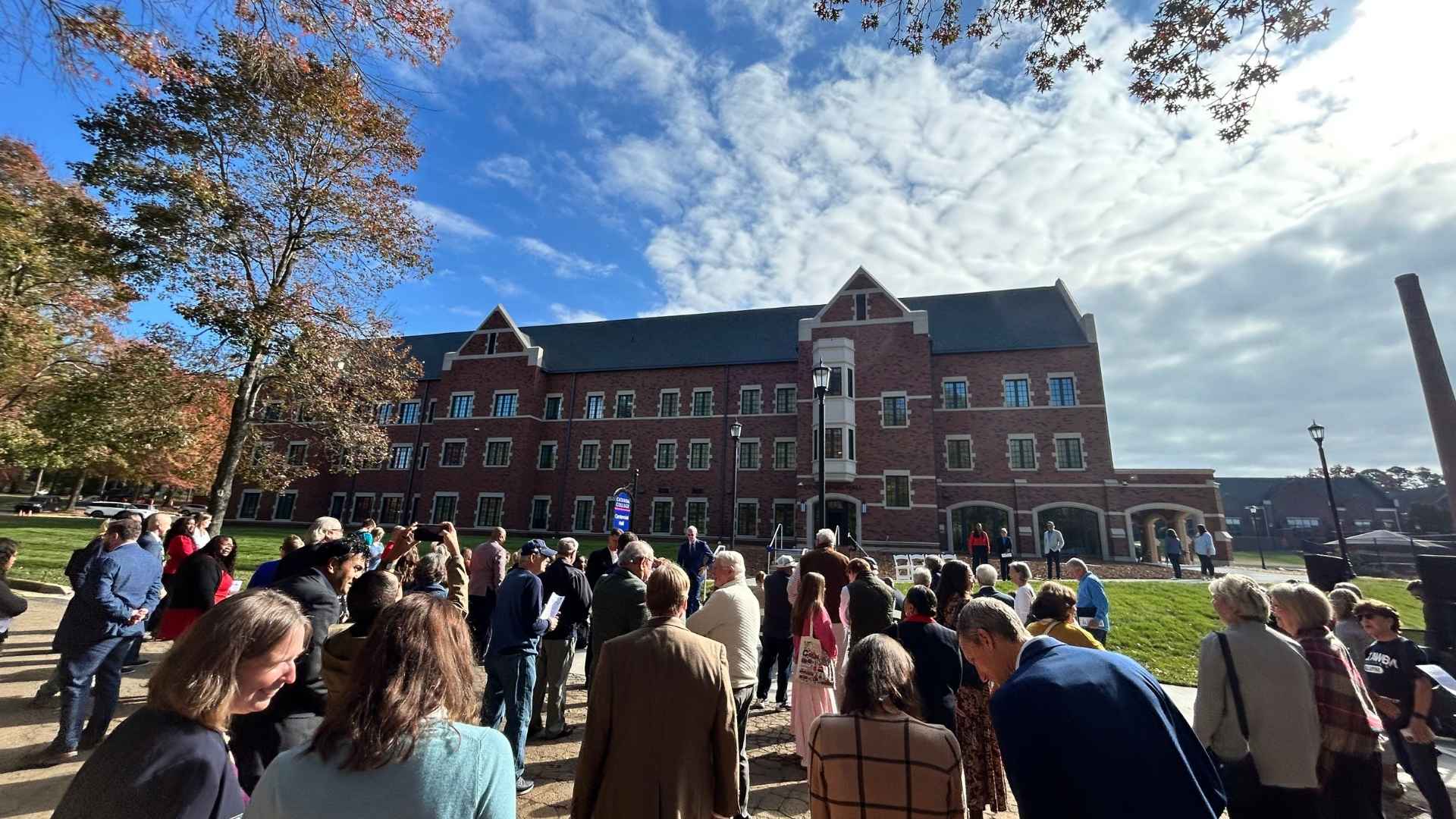
Students can also learn about the energy efficiency tests the college regularly conducts, such as blower door airtightness testing. Catawba partners with a company that conducts the tests, then shares and discusses the results with students. This turns the hall into a living-learning laboratory where students can dive deeper into energy efficiency and explore potential career pathways in the industry.
But Noah, the Sustainability Program Director, stresses that the building’s performance doesn’t all fall entirely on residents. Centennial Hall is airtight, which means it has quieter spaces to live and study and cleaner air to breathe.
“We want our students to not have to think super hard about how they are living, but just know that they are living in a responsible way because of the structure we set up for them,” Noah says. “They may not know or really care about all of the nuances, but that’s okay. Having a really nice experience and associating that with sustainability is the goal.”
E-Vroom! Catawba College’s Solar Racing Team
This summer, Catawba College participated in its first American Solar Challenge (ASC), a cross-country road rally for collegiate teams who design, build, and race solar-powered vehicles. Catawba’s team was one of the smallest and one of only three non-engineering schools among the 39 competing.
It started with flyers posted around campus asking, “Can you build a solar race car?” Students from Catawba and nearby community colleges answered the call, coming from many majors and backgrounds, united by an interest in cars.
“Since none of us are engineers, we get to learn and solve problems in non-traditional ways,” says Phoebe Dell’Arena, the team’s media lead and a sophomore Environment and Sustainability student at Catawba. Phoebe joined to learn basic car repair skills. “I remember my first time learning how to change a tire — it was on the solar car, which felt so cool,” she says.
After basic training from Appalachian State University’s team Sunergy, the team revived an old solar race car acquired from App State. Ten students traveled to the competition in Brainerd, Minnesota, along with two advisers: Noah, and Dr. Lee F. Ball Jr., Catawba’s Vice President of Sustainability and Executive Director of its Center for the Environment. Ball advised App State’s team for years. For two weeks, teams camped and competed at the track, an atmosphere Phoebe says felt like “another planet.”

“I’ve never been around people so competitive and passionate,” Phoebe says. “That’s what keeps me thinking about this trip: we did something we’d never experienced before, and we endured it with such resilience.”
After five days of grueling safety inspections, late-night work sessions, and even a windstorm that ripped the roof off their car, a defective battery module kept the team out of the race.
The team found other ways to stay engaged, from donating their hands-free radio system to the Georgia Institute of Technology’s team to lending a truck and trailer to a team from Montreal. In the end, Catawba won the Dr. James Hill Sportsmanship Award.
“It still felt like we won the whole race, based on how much we all got from the experience,” Phoebe says. “Just looking at the pictures that I took from the beginning to the end – our progress was crazy.”

Since returning to campus, team members have hosted open workshops on practical mechanical skills they learned from building the car, which can help students repair their bicycles or, for some, open career pathways for a school located in the heart of race country.
The team is already preparing for next year’s ASC track race: Phoebe just finished designing the team’s logo and branding, and they recently unboxed their next car. “We’re ready to go even bigger,” she says. “We really are starting this up. It’s so important and just feels special that I get to be here.”
The Smokestack: Once a Coal Plant, Not Always a Coal Plant
The tallest building on Catawba’s campus is its retired coal-fired power plant. It stands proud and bears the school name, though it hasn’t billowed black smoke since the 1990s.
This summer, Catawba College began the process of reclaiming the dormant building as a net-zero, carbon-neutral commons where students can spend time and study in one of the most visible symbols of Catawba’s decarbonization efforts. After all, the finished Smokestack will be LEED Platinum and Living Building Challenge certified, the highest green building certifications a building can reach.

There’s good reason why Catawba gave up burning coal – it’s dangerous, toxic, and outdated, to name a few – but they didn’t want to give up on the iconic building. Historic preservation of the college’s neo-Gothic architecture reminds the community of the school’s legacy, and reclaiming old buildings with a focus on the environment ensures that legacy will be an upstanding one.
The Smokestack will also be resilient: a battery fed by a 60 kW solar array will help keep power on in the event of extreme storms made worse by climate change, like the historic Winter Storm Gianna that hit Salisbury in February.
The old coal plant sits in the middle of campus – so the new Smokestack will be the heart of campus, Noah says. Right behind the student center, it will offer the best view of all Catawba has to offer: the school’s beach volleyball solar array, the lot where CatawbaGO vehicles park, and Centennial Hall right next door.
Join the Clean Energy Generation
Catawba College is one example of folks across the Southeast taking action to prioritize clean, affordable energy and make it accessible to everyone, no matter your age, income, zip code, or abilities. Like Catawba, we all can play a role in the clean energy transition. Join the Clean Energy Generation movement, and we’ll share ideas and tools for you to make a difference in your community.
Want to read more? Check out SACE’s stories about Catawba College:


