

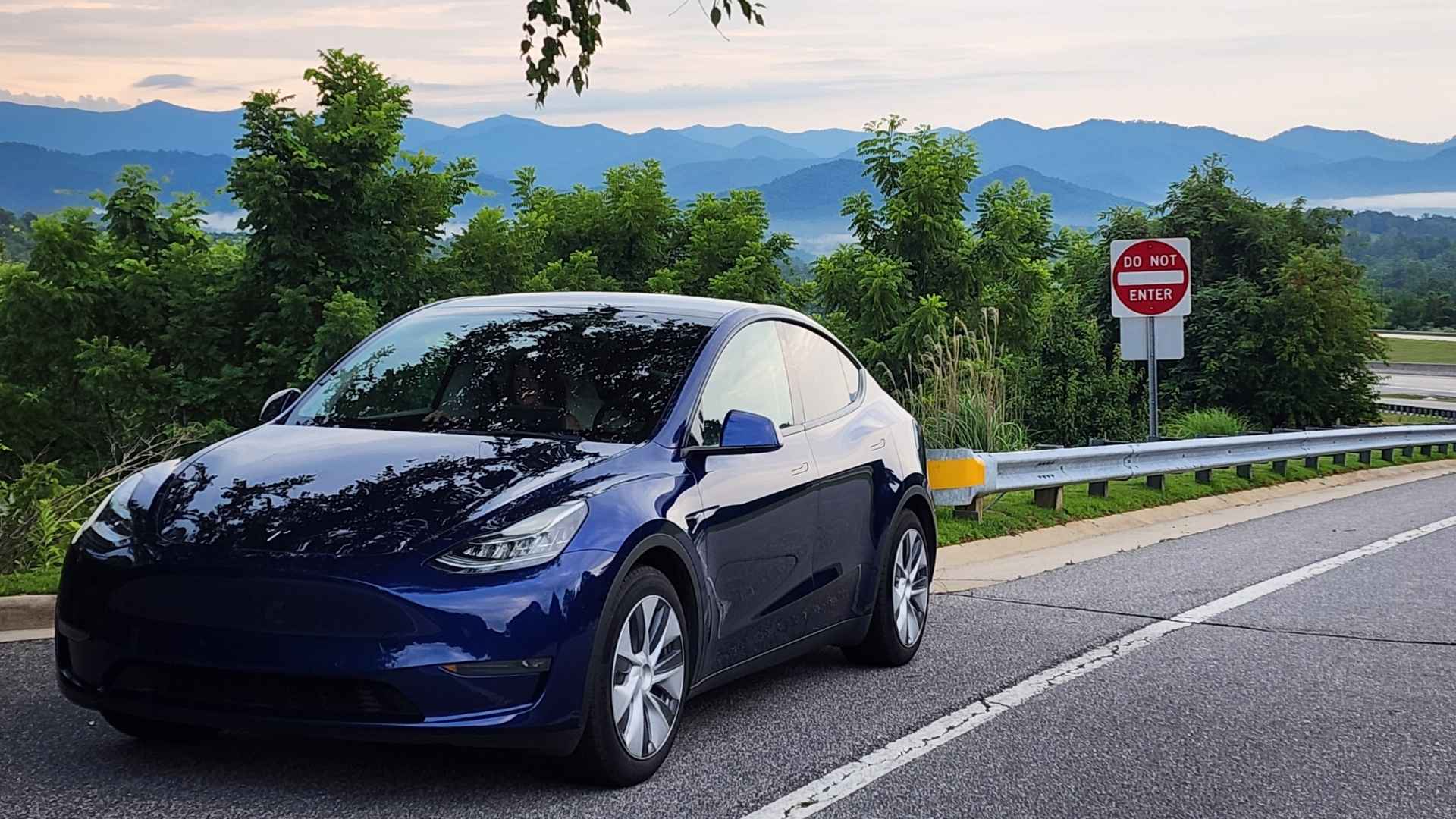
This article is Part Two of a three-part series about my 5,000-mile sabbatical road trip in an EV from my home in the southern Appalachians to the island of Newfoundland, and my reflections on what it means to be citizens and climate advocates as the planet overheats. Part One can be found here, and Part Three here.
The EV is packed. The route is set. We run through the final checklist. All boxes checked. We pull down our driveway and head north, ironically, into a heatwave toasting the east coast that is so severe, prolonged, and far-reaching that researchers have concluded it is “virtually impossible” that it could have occurred before humans began warming the planet.
My wife and I have been planning this six-week sabbatical road trip for a year, researching where we will go and how we will get there, leaving just enough to chance to maintain the element of surprise. As the tires start to turn down the highway, we are giddy with anticipation of the adventure ahead; it has been 30 years since either of us last took a road trip as sprawling as this one. We are headed to Canada’s Maritime provinces and the island of Newfoundland, 2,500 miles away, to camp amidst the splendor of national parks — Fundy, Cape Brenton Highlands, Kejimkujik, Terra Nova, Gros Morne — and explore remote and culturally rich towns like Chéticamp, St. John’s, Cow Head, Wolfville, and Annapolis Royal. We are raring to smell and taste the North Atlantic; to walk through boreal forests, over taiga highlands, and into deep fjords; to listen to Acadian sea shanties sung in old, wood-clad pubs.
This sabbatical trip will give me the experience of driving an EV for 40 days and 5,000 miles beginning on US highways and ending in the Canadian sticks. We have never gone on an electric road trip of this length or in such remote conditions. We will be relying on a network of public charging infrastructure that, at times, will be sparse. My wife and I have been driving EVs for over a decade, so we feel up for the challenge. As an advocate for the rapid electrification of our nation’s transportation system, I need to test the technology’s limitations and demonstrate its viability; I need to know what I am selling.
The trip will also put distance between me and the daily reminders of Hurricane Helene — eroded riverbanks, fallen forests, broken bridges, closed trails, condemned buildings — and give me room to sort through what a climate-induced disaster does to a person. I grew up trusting the planet to be stable. I knew, from the textbooks, that humanity’s flourishing had ridden on millennia of climate stability. I assumed that stability would hold for at least my lifetime. Hurricane Helene proved that assumption wrong.
The storm left me disquieted and vulnerable; angry at the politicians who sell us out to the polluters cooking the planet; sad about climate change’s human costs, whether from the floods in Texas, the fires in Los Angeles, or the storm in my own backyard; bitter about the plants and animals losing ground they can’t get back; and frustrated that solar, wind, energy storage, and EVs — the tools sitting right in front of us — aren’t being deployed fast enough to bend the curve. I packed these feelings into the car along with the tent, the food, the clothes, and the maps. They take up just as much room as anything else we’re bringing.
Driving Away
As we head north out of Western North Carolina and climb the steep igneous and sedimentary spine of the Blue Ridge, the sunrise backlights the high peaks to the east, rays shooting into the valleys, basking the misty morning canopy in butterscotch. We climb two thousand feet, crest over Sam’s Gap, and descend into Tennessee and the scoured Nolichucky River valley where floodwaters from Hurricane Helene surrounded the Unicoi County hospital and, in a daring helicopter rescue, 54 employees and patients were airlifted from the roof to safety. The six workers who died at the Impact Plastics factory further downstream were not so lucky. A pit opens in my stomach. Helene is riding our bumper like a tailgater.
Two and a half hours into the drive, we stop in Wytheville, Virginia, to charge the EV, which is down to 10% capacity. We get out and plug in. The charger makes its whirling sound as it pushes 250 kW of power into our hungry battery. The landscape has subtly changed. We’ve entered the rugged sandstone-and-shale ridges and rolling valleys of the Allegheny Range. A patchwork of green pastures and rows of knee-high corn fields unfolds in all directions. Lush hardwood trees meander like ribbons tracing the creeks. The smell of fresh-cut hay and dank cow dung wafts as the morning dew evaporates. The sun is still gentle on the skin, but you can tell the day will be a scorcher.
After twelve minutes of charging, we get back on the road, battery charged to 70%, bathroom visited, body stretched. We climb the ridge to the Continental Divide. We descend the other side and leave the last of the waterways that drain from the high North Carolina peaks where Hurricane Helene dumped feet of rain. We weave through a tight, forested gorge, and emerge into the Roanoke River Basin. Long north-south-running ridgelines emerge above the wide, silo-studded Shenandoah Valley, and the telltale signs of disaster vanish; green mosses still cover the river rocks, bridges and roads show no signs of washouts, and buildings still stand at the edge of the floodplain. We are 200 miles from home, and finally, the storm is in the rearview mirror.
The Electric Journey
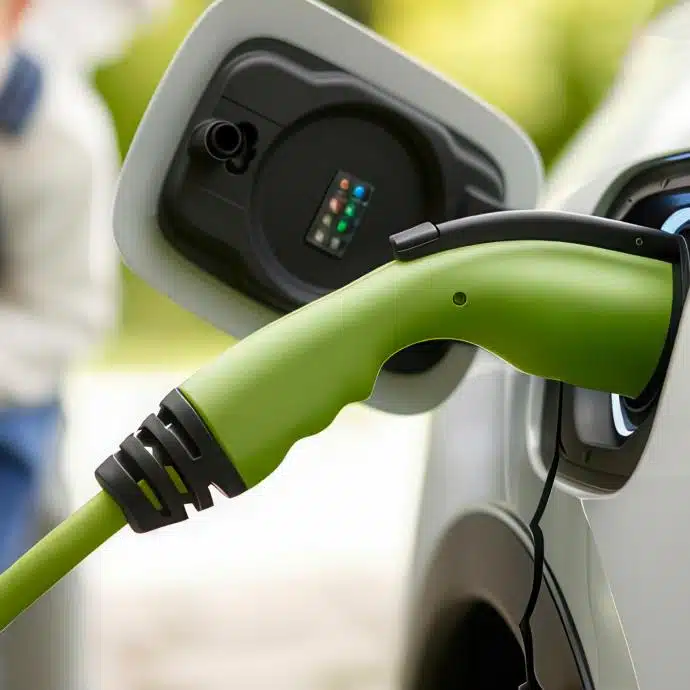
Driving our EV on this road trip will require us to charge our battery dozens of times, sometimes plugging into fast chargers along the highway like in Wytheville, and sometimes plugging into a wall outlet outside a quaint ocean-side inn overnight while we sleep. The fact that we need to charge means we have to look much more intently at the road ahead. If we were driving a gas car, we wouldn’t even think about it; we would just stop for gas at the nearest gas station whenever we needed to. But with an EV, even before we leave home, we know where we must stop to charge to reach our destination. There will be charging stops at breweries serving award-winning IPAs, at trailheads where we will hike to waterfalls, at visitor centers with exhibits we will wander through, and at towns off the beaten path that we would not otherwise have discovered. You could look at an EV as slowing down the road trip, but I see it as deepening it.
What I love most about driving an EV is that it emits up to 80% less climate pollution over its lifetime than a gas car. Heck, when we get to Newfoundland, where 97% of the electricity is generated by hydropower, we will be driving on water. Whereas electricity can be clean, oil is always dirty. An EV is a way to clean up at least some of my conflicted climate complicity. I love to travel to exotic places by plane, which creates a lot of emissions. I eat meat, and although I try to eat local, my diet adds more emissions. I have an energy-efficient home with a little plug-in solar system in the backyard, but that’s not enough. I grow a garden, which doesn’t amount to a climate hill of beans. I am part of the problem. We all are. And while we should take stock and work to minimize our individual impacts, the blame for the climate predicament does not lie at our feet.
The Problem Is Bigger Than Us
We are living in an economic system that gives us few options: electric utilities keep burning fossil fuels instead of fully embracing renewable energy; automakers keep sending gas-burning cars to showrooms instead of doubling down on EVs; airlines keep burning refined kerosene instead of demanding biofuels; industrial agriculture keeps mechanizing and chemicalizing our food system; oil companies keep drilling for more fossil swamp goo. Technology innovation drives industry, but industry also gets the technological innovations it asks for. Our climate impact is the output of our personal choices multiplied by far weightier political and corporate decisions. We can’t fix this problem person by person; we need system-level change to address the systemic challenge of climate change.
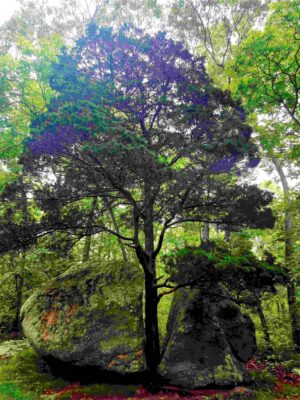
Despite our individual limitations, I have always felt motivated to do my part. My motivation stems from my childhood: I grew up in Guilford, Connecticut, near the shores of Long Island Sound, on a landscape of rocks long ago dumped by retreating glaciers. When I was a child, I ran wild through the woods. I played on and around the thousands of boulders sitting stoically in the forests, or stacked into piles, creating fissure caves and their Fat Man Squeezes. I leaped over the hundreds of miles of rock walls laid by pioneers after they’d plowed the stony ground. I asked the adults, “Where did all these stones and boulders come from?” Most didn’t know, but some did, and they would say, “Canada.” They would tell the story of the last ice age and the mile-high ice sheet that scraped across Canada and northern New England, stopping where I stood and dumping plowed earth. My imagination was sparked; I would stand at the edge of my yard, look back at my family’s 1970s ranch-style house, and imagine the glaciers moving towards me like a giant snowplow coming to dump rocks and boulders on our doorstep. The thought made me shiver; if I were alive then, the Earth would have killed me. But that awareness also gave me comfort; the ice age was long ago; I am safe now.
Reckoning With The Tensions
The long drive through Virginia tightens the back and cramps the legs. Morning gives way to afternoon by the time we arrive in Martinsburg, West Virginia, and we’re ready for a break. We stop to charge the EV at a Sheetz convenience store before crossing the Potomac River into Maryland. I step out of the car and am awash in hot air rising off the asphalt parking lot and the acrid smell of the upwind gasoline vapors from the dozen pumps in use. We are the only EV plugged in at the eight chargers. I wonder when this will flip — when the gas pumps sit idle and the chargers are overwhelmed with demand. Someday.
We get back on the highway, and I zoom out the map display on the car’s screen to see the full stretch of highway between here and Canada; 200 miles more to go today, another 400 tomorrow, and 320 the next. Are we crazy? I zoom out further to see the 2,000 miles beyond that, through Canada, still to come. Are we really driving to Newfoundland? Is this going to work in an EV?
I stop focusing on the distant bucolic scenery and hone in on the detritus at the edge of the highway, which has been there all along, but ignored. The towering billboard ahead reads, “Unleaded $3.66, Diesel $4.80,” in bright green and red LEDs. The next one welcomes truckers with hot showers. The next promises to turn your wreckage into a windfall: “I’ll fight for you!” On another, a cartoon beaver tells me, “You can hold it, only 177 miles!”
My grip on the wheel tightens. Driving the highway doesn’t feel like a choice anymore. I feel the other end of the journey reaching back in time and yanking us forward. We chose to take this trip, mapped it out, made the reservations, carved out the time, but I can feel inertia creeping in. Already, the road trip is generating its own momentum and accumulating the weight of its expectations. I push down on the pedal. It feels like there is no turning back, like when I was a little boy standing on the edge of a pool, slowly leaning ever more forward until gravity took hold and plunged me in.
At the same time, I feel the tension between me as a person making individual choices, and as a consumer strapped into an economy that, like this highway, is built to keep us moving and burning fossil fuels. The problem is if America keeps traveling down its current energy path, by 2050, climate-polluting fossil fuels will account for 77% of energy production and renewables only 22%. That won’t work: the world’s climate scientists agree that avoiding catastrophic warming means slashing fossil fuel use and getting almost all our electricity from renewables by 2050. That’s our conundrum: will we make new choices, or will we let the inertia of the systems and structures we have built over the past 250 years propel us into an ever warmer world?
I think again of the boulders in the woods of my childhood. The visceral awareness that the Earth’s climate has been violently different in the past hones my awareness and deepens my perception of what we are messing with. The climate’s remarkable stability over the past 12,000 years is what has allowed our species to thrive. Sure, there have been moments of chaos; winters that lasted for years, volcanoes that covered the planet in soot, earthquakes that swallowed cities. But at the macro level, there has been balance. Today, there is increasing chaos. And what I know from growing up amidst the boulders of the last ice age is that the Earth’s climatic system sustains life, and it takes it away.
Maybe part of the answer to where we go from here is to start claiming our agency, to start owning the fact that climate change results from choices we make as consumers, and more impactfully as voters who continue to elect leaders unwilling to lead on climate. We can make different choices. We can elect different leaders. We can pump the brakes, take the exit ramp, and leave our fossil-fuel past behind. Or maybe the inertia is too strong.
As I sit with my own tension between agency and inertia, I also wonder how the Canadians we will meet are reckoning with theirs, how they are experiencing and adapting to climate change, and where they hope we go from here. Before I can find out, my wife and I have to ride America’s highways along the East Coast’s Appalachian chain, traversing Pennsylvania’s Pocono Mountains before crossing New York’s Taconic range, following Connecticut’s Litchfield Hills, and into Massachusetts’ Berkshires and Maine’s coastal Longfellow Mountains. It’s a long road ahead.
Stay tuned for Part 3.
I am publishing this series while on a six-week sabbatical road trip with my wife in our electric vehicle. We are driving to Newfoundland, Canada, following the Appalachian Mountains from their southern to their northern edge. The road trip will serve as an adventure to free our minds and escape routines; an opportunity to talk to our Canadian neighbors about their experiences with climate change; and a metaphor for reflecting on what it means to be citizens and climate advocates as the planet overheats. Stay tuned for the other articles I will write along the way.


