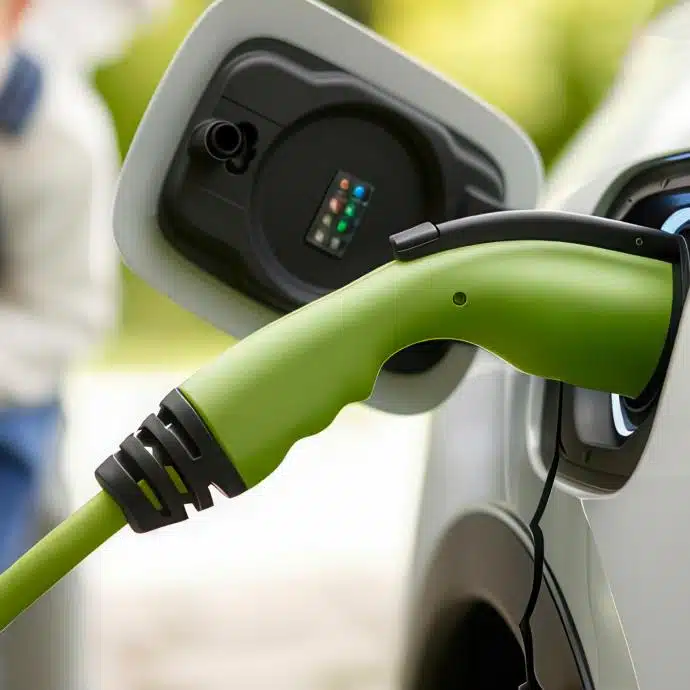


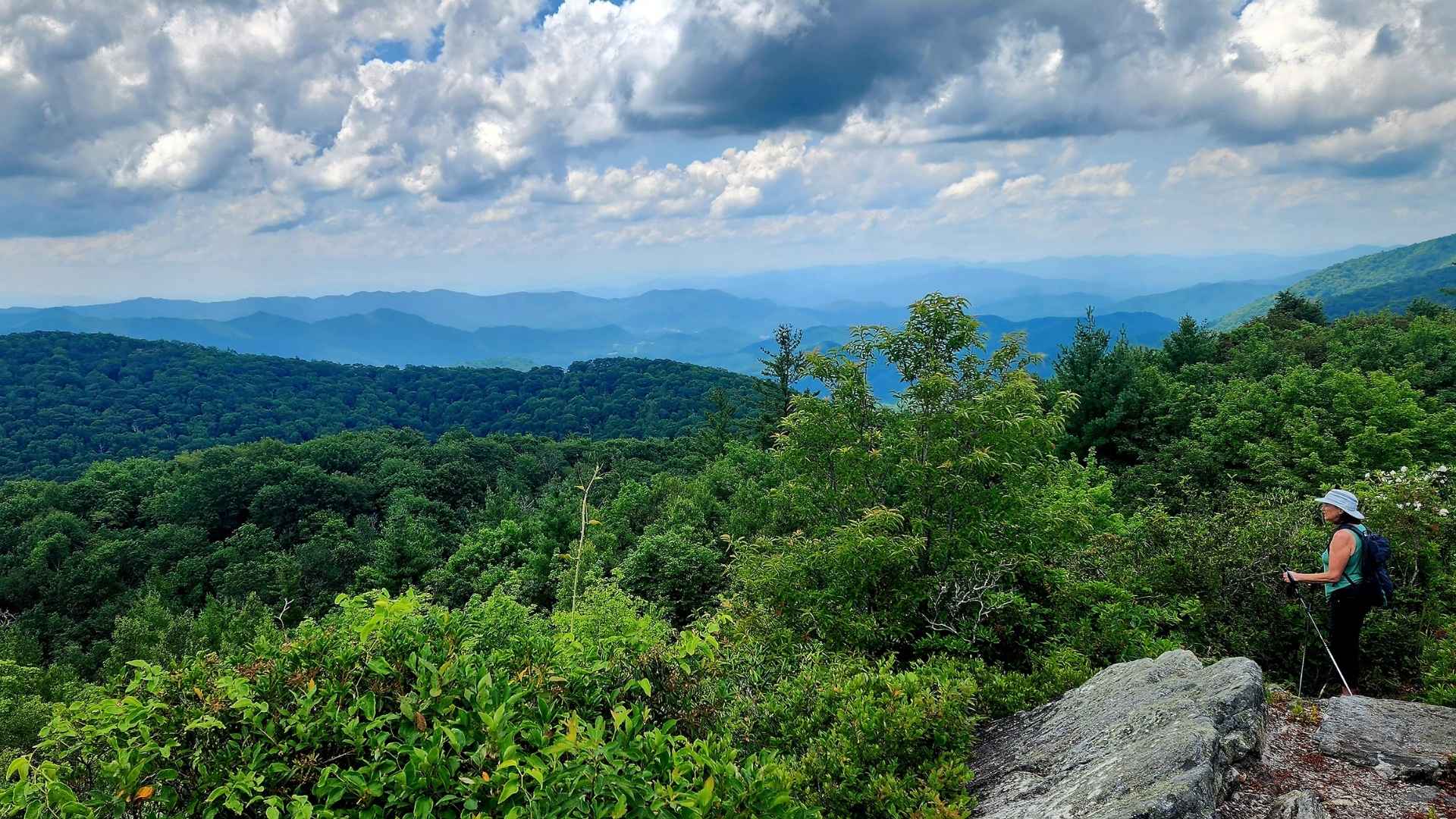
This article is Part One of a three-part series about my 5,000-mile sabbatical road trip in an EV from my home in the southern Appalachians to the island of Newfoundland, and my reflections on what it means to be citizens and climate advocates as the planet overheats. Part Two can be found here, and Part Three here.
On a Thursday morning in late September 2024, I was sleeping in a Detroit hotel room at 3:00 am when I was awoken by a text from my wife: “You need to come home now.”
Blurry-eyed, I opened my weather app and saw why: radar showed the southeastern U.S. blanketed by the dark greens, yellows, oranges, and reds of a serious storm. I pressed play to put the map in motion and gasped at what I saw. Hurricane Helene had churned out of the Gulf of Mexico and made an eastward turn at the southern tip of the Appalachian chain. There was no longer any doubt that our home in the mountains near Asheville, North Carolina, was going to get a direct hit. By 7:00 am, I boarded a flight home, and not a moment too late, as the plane would be the last to land at the Asheville airport before winds would whip over 100 mph, rivers would crest over 30 feet, muddy mountainsides would slide into the valleys below, and the consequences of a warming planet would wreak havoc on my community.
The flight was an armrest grabber. Instead of taking the normal southerly route, the pilot flew east out over the Atlantic until we reached the North Carolina coastline, then made a ninety-degree westerly turn, pointing the plane directly into the storm. As I stared out the window, graphite gray plumes of clouds billowed as far as I could see, until they engulfed us. The plane sloshed into the storm’s outer bands, zigging, zagging, rising, and falling. The pilot didn’t need to tell passengers to remain seated with our seatbelts fastened; fear held everyone firmly in place. An hour later, as the landing gear lowered, the plane broke through clouds above the mighty French Broad River, which had already broken its banks. Water was everywhere. The valley floor of fields and forested hills was transformed into a string of islands rising from an inland sea. After we landed, I ran out of the airport through the driving rain to my Tesla. I turned on my navigation and saw that the highway home was still open. I raced to get there.
When The Professional Becomes Personal
I have spent my 30-year career as an environmental educator, sustainability practitioner, clean energy entrepreneur, and climate advocate. I am steeped in the science of global warming. I have a grasp on what is at stake economically, socially, and environmentally if we do not take steps to address the root causes of climate change and stop planetary warming. I have read the books, attended the conferences, and taken the trainings. Yet I had never lived through a climate-intensified natural disaster; I had never felt the destructive, upending force of global warming. Despite my textbook understanding, I was sheltered from the first-person experiences that people in other areas had already lived through. Hurricane Helene obliterated my naivety.
I was introduced to the concepts of human-induced climate change and the risks of a warmer climate long ago. In 1989, in my high school environmental studies class, we read Bill Mckibben’s book The End of Nature, often cited as the first book written for a general audience about climate change; learned about the Global Warming Prevention Act that Congress passed in 1988 to create coordinated national and international policy on climate change; and listened to NASA scientist James Hansen testify before the Senate Energy and Natural Resources Committee, warning that global warming had begun and was attributable to human activity.
Thirty-seven years later, the most frustrating thing about being a climate advocate is the need to be one. When I began my career in the late 1990s, I assumed I would eventually work my way out of a job. Surely, with all the climate science and evidence blaring bright-red warning signs about the human risks and economic costs of unabated global warming, world leaders would come together to address the problem. That seemed sensible. But whenever the opportunity presented itself, the United States blocked, diluted, or slowed progress. Our political leaders have failed to lead; in that void, polluters keep polluting.
Seeing Through The Eye Of A Storm
My wife and I couldn’t sleep. The rain pelted the windows like pebbles. We could feel the force of the wind pushing against the house, as if it were determined to lift it off its foundation. In the darkness, we heard loud cracking and splintering. By daybreak, the worst of the storm had passed. Dawn colored the ground in shards of silver. We got up, looked out the window, and did not recognize the view. An uncountable number of trees were scattered across the landscape like piles of giant sticks dropped from on high. It was eerily quiet. There was no power, no internet, no cell service, and no way out.
By midday, the quiet was broken by the roar of chainsaws as neighbors worked together to cut paths through the walls of downed trees. Information started trickling in through unreliable word-of-mouth and somber radio hosts broadcasting from Asheville’s public station. We sat in our car and desperately listened to what little the broadcasters could tell us, based on what they could gather from shocked local officials and first responders. It was grim. We were in a collective state of panic.
It would take another day of chainsawing through trees before we could squeeze our car through gaps in the debris to the highway and drive the 25 miles across town to see if my elderly parents were okay. The last we had heard from them was right before the eye of the storm cut off contact as they were hurriedly preparing for evacuation, fearing the dam upstream from their neighborhood was about to breach. The drive to their house was harrowing and heartbreaking. The verdant canopy-covered mountain slopes rising thousands of feet from the valley floor were streaked with swaths of brown earth laid bare by landslides and pocked with hundred-acre patches of snapped trees, their ragged trunks poking into the gloomy sky. The highway was littered with an obstacle course of dirt and rocks. The electrical grid lay flat on the ground, with hardly a power pole left standing. We drove over countless power lines, the muted thump under the tires further unnerving us.
The French Broad and Swannanoa Rivers were still high above their banks, though we could tell they had receded by the bits and pieces of houses and buildings lodged up in the canopies of the old sycamore trees that, somehow, still stood. Structures near the rivers, many of which were outside the historic floodplain, were either washed away or buried in feet of shimmering terracotta-colored mud. Cars and trucks were strewn and piled along the banks like heaps of Hot Wheels on a child’s bedroom floor. Emergency vehicles raced in every direction, sirens blaring. When we got off the highway, washed-out roads and twisted bridges made it impossible to drive all the way to my parents’ neighborhood, so we walked through the devastation to reach them. We found them scurrying from house to house, notebooks in hand, checking on their neighbors, noting whose houses were flooded and who needed water, food, or medical help. When they saw us, we all burst into tears.
The storm smashed wind-speed records, raised the rivers higher than any prior flood, and reshaped the region’s geology. Hurricane Helene’s human toll is measured in 250 lives lost, including 157 people around Asheville; thousands of people lost their homes; hundreds of thousands of people throughout the region were left with impassable roadways and without power, clean water, internet, and cell service. Infrastructure impact resulted in 125,000 housing units damaged or destroyed, 6,000 miles of roads, more than 1,000 bridges and culverts, and 160 municipal water and sewer systems damaged. The economic costs of Hurricane Helene have reached $80 billion in damage, with $60 billion in North Carolina alone, where 96% of property damage from the floods and landslides was uninsured, leaving residents with a generational financial burden. Geologically speaking, the mountains moved. More than 2,000 landslides pushed rocks, trees, mud, and everything else in the way into the region’s valleys. They added an estimated 6.6 million cubic yards of material to the raging creeks and rivers. In the months after the flood, it would take 85,000 dump-truck loads to remove the debris, an amount that could fill roughly 17 NFL stadiums.
Nothing Left To Debate
Unlike in the 1980s when we were first publicly debating climate change, today there is unequivocal evidence that human activity, namely burning fossil fuels and releasing carbon dioxide and other greenhouse gases into the atmosphere, is warming the planet at an unprecedented rate; so says NASA, NOAA, and EPA, the National Science Foundation, National Academies of Science, American Meteorological Society, American Geophysical Union, American Association for the Advancement of Science and the 782 scientists from over 65 countries who contributed to the most recent Intergovernmental Panel on Climate Change global assessment. An estimated 97% of the world’s scientists agree with the volumes of peer-reviewed research concluding that global temperatures today are warmer than in pre-industrial times and that human activity is the most significant factor. Zero percent conclude that a viable path out of the climate crisis includes continuing to burn fossil fuels. Only the oil and gas industries argue we can burn our way out of the problem, and they spend a lot of money to ensure politicians let them: the industry ranks among the top 5 highest spenders on federal lobbying, having spent nearly $150 million lobbying Congress in 2025, in addition to untold campaign contributions.
Politicians and polluters work to cover themselves through sophisticated campaigns spreading disinformation rampantly in echo chambers of 24-hour news channels, podcasts, and social media channels with a single purpose: to sow climate change doubt. Americans are bombarded with messages that climate change is not a problem; it is the Earth’s natural cycle; carbon dioxide is a plant-food, so the more the better; windmills cause cancer; climate scientists are only in it for the grant money; renewables can’t power a modern economy; climate change is a hoax and clean energy a scam. These messages range from miscontextualizations to exaggerations to full-throated lies. Still, they shape beliefs and sow division, rendering a hyper-polarized citizenry incapable or unwilling to hold political leaders accountable for holding polluters to account. This is the thing that burrows deepest under my skin: even with decades of empirical evidence and clean energy innovation that together make the case for climate action and provide the technological capacity to act, even with an increasing number of Americans experiencing disasters and becoming concerned about global warming, climate advocates are losing the narrative battle.
Humans are captivated by stories, and the fossil fuel industry keeps writing best-selling fiction while our non-fiction piles up in discount bins.
Where Do We Go From Here?
I was drawn to the mountains of Western North Carolina, to the Asheville region, because I love the land and culture. I settled here, in part, because it is, or was, seen as a climate haven; a region where the extremes of climate change would be lessened by its distance from the ocean, elevation, mountain topography, lush forests, and abundance of fresh water. Hurricane Helene showed us that nowhere is safe. Researchers have concluded that global warming was a driver of Hurricane Helene’s impact: record-hot sea surface temperatures in the Gulf of Mexico — temperatures made 200-500% more likely because of climate change — fueled Helene’s great strength and speed, allowing it to move more quickly and forcefully inland. Drawing in tropical moisture from Helene’s outer edges, bands of torrential rain battered the Southern Appalachians for days preceding the storm’s arrival, soaking and loosening the soils, filling creeks and rivers, and setting the conditions that led to the devastation. When the storm arrived, its record rainfall was made 70% more likely by climate change.
Not every natural disaster is climate-induced, but many increasingly are. The likelihood of one happening where you live increases with every barrel of oil, cubic foot of fossil gas, and ton of coal we burn. That fact alone should be motivation enough to demand an aggressive and politically unified transition to clean energy, but so far it’s not. Twenty-one months on, my community is still recovering, and I still can’t shake Helene. The normal cracking thunder, gusting winds, and pouring rains of summer storms trigger me; I no longer trust the trees to stand, the rivers to stay in their banks, or the mountain slopes not to slide. The storm left me with a question I can’t shake either: “Where do we go from here?” This is the question I am chasing toward the far reaches of the continent.
Stay tuned for Part 2.
I am publishing this series while on a six-week sabbatical road trip with my wife in our electric vehicle. We are driving to Newfoundland, Canada, following the Appalachian Mountains from their southern to their northern edge. The road trip will serve as an adventure to free our minds and escape routines; an opportunity to talk to our Canadian neighbors about their experiences with climate change; and a metaphor for reflecting on what it means to be citizens and climate advocates as the planet overheats. Stay tuned for the other articles I will write along the way.


