


Press Mention Columbus Ledger-Enquirer August 12, 2026
SACE Referenced
Georgia Power's OpenAI contract shrouded in secrecy as PSC weighs transparency concerns
In this mention
The Georgia Public Service Commission held a hearing on Georgia Power's 3.2-gigawatt power contract with OpenAI, which has been entirely redacted citing trade secrets. Multiple organizations, including the Southern Alliance for Clean Energy, Sierra Club, and NRDC, submitted objections to the contract's lack of transparency. Commissioner Peter Hubbard and others raised concerns about cost allocation to ratepayers and the need for greater public disclosure before approval.
Original clipping
PDF didn't open? Open it in a new tab →
Full transcript
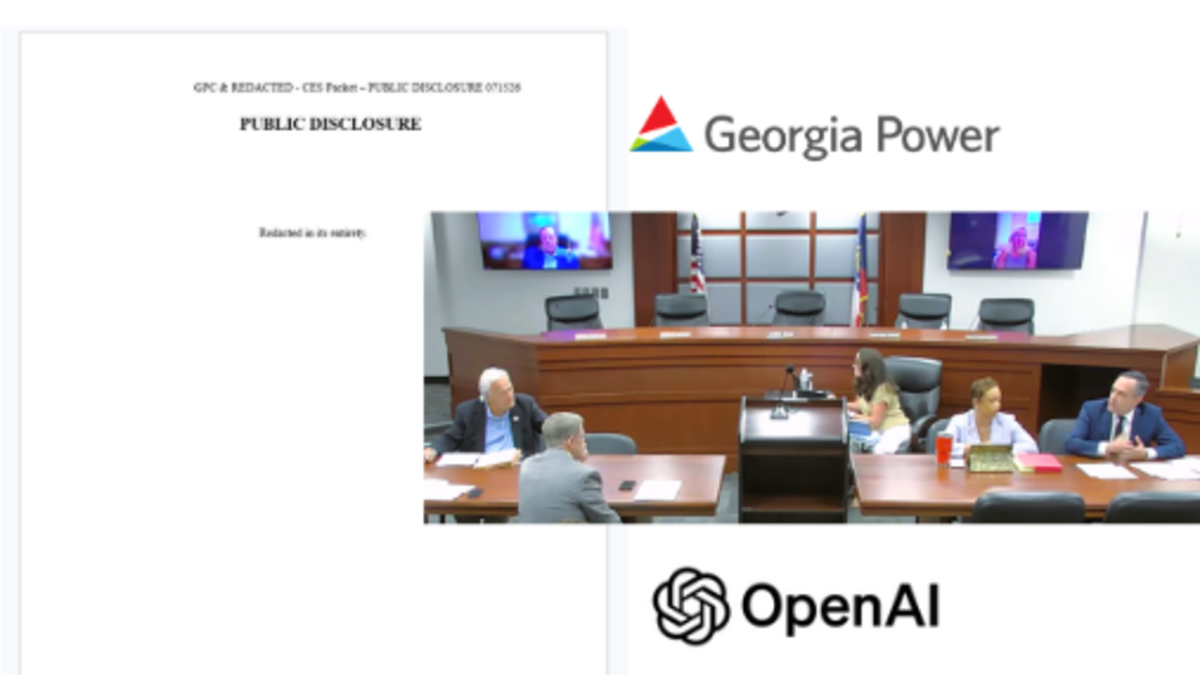
Fully redacted contract between Georgia Power and OpenAI for their large load contract sent to the Public Service Commission July 15, 2026, until it was changed to July 22 on Aug 13 shortly after the Public Service Commission hearing. Three public service commissioners appear in person, two on Zoom screens.
The word 'transparency' was said 17 times and the word 'time' was mentioned 21 times in a 35-minute exchange during a public hearing Thursday at the Georgia Public Service Commission.
Freshman Commissioner Peter Hubbard (District 3) raised concerns about the 3.2-gigawatt power contract between Georgia Power and OpenAI, which only commissioners, PSC staff and Georgia Power have seen during the past 29 days.
The contract is a requirement from the April 2025 rule the PSC created: All new contracts with large loads over 100 megawatts must be reviewed and approved by PSC staff for the company "to appropriately assign costs to the customer."
The contract, submitted July 15, was "redacted in its entirety," citing trade secrets, leaving the public with ambiguity about cost.
Several organizations, such as the National Resource Defense Council, Sierra Club, Southern Alliance for Clean Energy and 100 Miles, submitted requests for objections to commissioners Wednesday evening and Thursday morning ahead of Friday's deadline.
During the PSC hearing Thursday morning, ahead of Friday's 30-day decision expiration. Hubbard said the contract should be objected as it stands until "sufficient financial guardrails are in place."
"This is a contract with 3,200 megawatts, the equivalent of three cities of Atlanta's worth of power," he said. "I don't know where we're going to find three cities of Atlanta's worth of power customers to backfill a contract like that if it was terminated early."
That much energy is the entire capacity of the largest coal power plant in the United States, Plant Bowen in Bartow County, Georgia, at 3,376 MW.
Hubbard suggested the 2025 rate freeze made it so the PSC doesn't know the true cost of hyperscale data centers, and there is a risk from surety bonds and customers will be taking on huge costs.
He said his objection would "buy time to examine this."
Tom Bond, utility director of the PSC Public Interest Advocacy Staff, admitted to Hubbard, as the contract stands, they planned to file an objection Aug. 14.
If there were an objection, the five commissioners have 30 days to take action on the objection, according to the April 2025 rule.
Hubbard received support from Commissioner Alicia Johnson (District 2), whose district contains the site for where the OpenAI project is planned to be developed. Johnson said she has received a slew of phone calls and emails from constituents about worries for cost.
"Any customer requiring this amount of energy should expect equal amount of rigor and scrutiny; that's our role," she said.
Commissioners Jason Shaw (District 1) and Tricia Pridemore (District 5) thanked the staff for their hard work and working overtime. Pridemore said she does not want to do anything to "impede or get in the way of negotiations".
After commissioners spoke, eight public witnesses came forward to address them. Six of the eight mentioned "transparency" and "time" during their comments.
Five hours later, Georgia Power issued a letter stating the effective date of the contract filing is no longer July 15 but July 27, extending the review period to end Aug 26.
"(This) gives time to provide staff with additional information," Tom Krause, public information officer for the PSC staff, said in an email to the Ledger-Enquirer.
More time, more transparency, less concern
During Thursday's hearing, Jeffrey Beauvait, an advocate for the coastal education and protection nonprofit 100 Miles, asked the commission staff to not only object to the contract but for the commission to change the April 2025 rule from a 30-day review to 60 days and for the commission be part of the process, not just the PSC staff.
"Georgians deserve transparency and access to basic information needed to engage in informed discussions," he said. "That's especially true for contracts that will have far-reaching consequences for their communities."
Mark Woodall, legislative chairman for the Sierra Club, told the PSC during public comment other states are more transparent than this and an entire redaction is not going to gain the trust of the people of Georgia.
Beth Levine of DeKalb County called the redaction "outrageous," that every single word, technical or non-technical, was redacted.
"I'm a psychologist," she said. "The problem with it being fully redacted is then, it's human nature to project the worst from the lack of information."
Commissioner Johnson said she challenged the level of transparency and causing speculation and had a conversation with Georgia Power regulatory affairs director Jeremiah Haswell.
Commissioner Bubba McDonald immediately responded, saying, "I love the word transparency. I'm sorry I wasn't invited to your meeting with Georgia Power, but we'll go from there."
"Well, Georgia Power invited us," Johnson said.
Though the capital expenditures negotiated between OpenAI and Georgia Power aren't disclosed because of the redacted public document, CEO Chris Womack of the Southern Company, Georgia Power's parent company, suggests 1 gigawatt is equal to about $2 billion in expenditures. That would be about $7 billion for 3.2 GW project.
"A decent rule of thumb to think about capital opportunities going forward is about $2 billion or so, a little bit above maybe, related to a gig of new generating capacity," Womack said during the Q2 earnings call.
The Ledger-Enquirer asked Georgia Power why they cited trade secrets if the project is announced in Effingham County, therefore not competing with other states, and they aren't competing with other companies in the state (EMC's, MEAG, TVA).
Georgia Power media relations and corporate affairs spokesperson Tiffany Anthony responded with the following in email:
"Some filings we make with the Georgia PSC contain proprietary financial information for Georgia Power that, if made available publicly, would hurt our ability to negotiate the best terms on behalf of our customers and could raise costs for all customers. These large loads can locate in any state, so Georgia Power is competing for large loads within the state of Georgia as well as with utilities in other states. These filings and the contracts also contain confidential and proprietary information belonging to our large load customers, which is commercially sensitive and protected by nondisclosure agreements with which Georgia Power must comply."
The company likened the disclosure of this information to the same as residential customers' information.
" We cannot unilaterally disclose their confidential business information — just as our residential customers expect us to protect their personal account information and electrical data," the email says.
The Ledger-Enquirer also asked how the redaction of an entire document is in line with their Customer Protection Pledge.
"This approach and our compliance with state law and regulations is 100 percent aligned with our Customer Protection Pledge," the email says.
This story was originally published August 13, 2026 at 4:55 PM.