


The Bipartisan American Affordability and Jobs Act of 2026 (BAAJA), a federal permitting reform bill that represents a compromise between clean energy and fossil fuel industries and was first introduced in September, is under Senate consideration.
BAAJA contains several major infrastructure policy overhauls, including modernization of transmission planning that would support clean energy and undermining of existing biodiversity protections that would help fossil fuels.
In the Southeast in particular, where it is already much easier to permit and build fossil fuel infrastructure, the removal of impediments to both clean energy and fossil fuels is likely to help fossil fuels more than clean energy.
Proponents of the bill argue that the lack of proactive regional transmission planning is stalling clean energy deployment, and that BAAJA will lead to transmission that can unlock it. Proponents claim that better transmission planning will level the playing field for clean energy to compete against fossil fuels.
Critics argue that fossil fuel projects already have an easier time getting built, and bringing down potential roadblocks for them does not level the playing field, particularly in the Southeast, where vertically integrated utilities control transmission planning instead of an independent, wholesale transmission operator.
The intent of the permitting bill is clear — to ease impediments to building clean energy at the speed required to meet the demands of the clean energy transition. SACE has long advocated for building more clean energy faster to reduce pollution, mitigate climate change, and lower customer bills.
While we support the intent and key aspects of the bill, SACE cannot support a permitting bill that gives fossil fuels so much of a giveaway and doesn’t do enough to level the playing field for clean energy here in the Southeast.
If BAAJA is going to promote clean energy for the Southeast, it must be reworked to strengthen provisions for non-market regions and soften the giveaways to the fossil fuel industry.
The Good: Modernized Transmission Planning
BAAJA’s transmission provisions include changes to both planning and permitting. Since the Southeast is behind the rest of the country on planning, and permitting comes later in the transmission-building process, the bill’s transmission planning provisions are more immediately relevant in the Southeast.
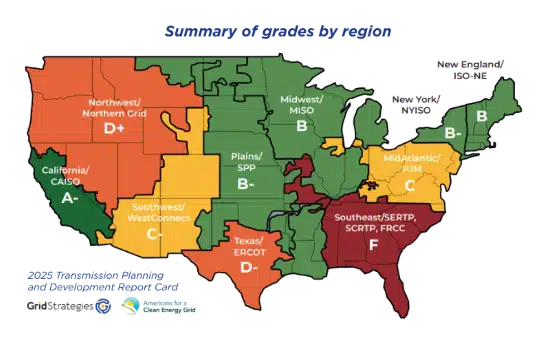
BAAJA codifies existing regional transmission planning regulations, requires inter-regional transmission planning, empowers state commissions to investigate a utility if it has concerns that the utility’s local transmission planning practices are harming customers, and requires transmission organizations to speed interconnection for generation resources. These are all good and necessary steps to getting more clean energy through the interconnection grid and onto the grid faster. However, the Southeast, with its vertically-integrated utility structure, will be left behind.
First, the important steps toward a consolidated planning process between transmission and generation, that is both transparent and proactive, are what SACE has been advocating for in the Southeast for years. However, the manager’s amendment removes this requirement for vertically integrated regions. This is very convenient for the vertically-integrated utilities in the Southeast.
Second, the strengthening of FERC’s oversight of local transmission planning is also important. However, the bill’s provision on this matter leaves it up to state Commissions to petition FERC for this oversight. Many state Commissions in the Southeast are captured by the utilities they regulate and believe the utilities when they are told that transmission planning is going just fine and there’s no need for additional oversight.

The bill’s provisions on regional and interregional transmission planning apply to the Southeast and would help improve reliability and affordability in the long run, as well as potentially speed interconnection through stronger regional and interregional grids. However, in the Southeast, transparency and bias in transmission planning are ongoing issues, and the bill does nothing to fix the “black box” or utility incentives to continue to check the box for regional transmission planning while only building local transmission lines.
In addition to its planning provisions, the bill provides FERC the ability to backstop permitting for transmission in the national interest. If FERC had had that authority ten years ago, the Clean Line transmission line proposal that would have connected Oklahoma wind to the Southeast through Memphis could be energized today. With that line, Southeast utilities might not have had to resort to blackouts during Winter Storm Elliott in 2022.
The bill also specifies four categories of grid-enhancing technologies and requires utilities to use the best available technologies when the benefits exceed the cost. FERC must penalize any public utility that fails to deploy advanced transmission technologies when the applicable benefit-cost ratio exceeds one.
In the long run, many, but not all, transmission sections of the bill would benefit clean energy in the Southeast. But key transmission sections neglect the Southeast because of our vertically-integrated structure.
The Bad: Weakening Environmental and Consumer Protections
The Clean Water Act
Under BAAJA, benthic communities and wildlife, i.e., plants and animals that live on the bottom of the waterways, would no longer be considered in assessment for 401 state certification under the Clean Water Act, making the water quality itself the only metric for certification.
This provision would render Endangered Species Act reviews, which would also be shortened under BAAJA, effectively useless.

Also under this provision, transmission line and interstate pipeline assessment would be limited to “direct point sources,” meaning that damages caused by upland erosion during construction, a recurring issue in pipeline construction, and impacts to wetlands would no longer be considered in water quality standards assessments. Although pipeline construction poses numerous risks to water quality, it has few to no “direct point sources,” meaning states would have little grounds to deny 401 certification of a pipeline or transmission project.
Several additional water permitting weaknesses exist in BAAJA, but the direct point source restriction makes most of them moot.
The National Environmental Policy Act (NEPA)
Secretive Precedent Agreements
One proposed reform to the National Environmental Policy Act (NEPA) states that “no federal agency shall be required to consider any specific or technical research that becomes publicly available after the date of publication of a notice of intent or a decision to prepare an environmental document for a proposed agency action.”
Under this regulation, the Federal Energy Regulatory Commission (FERC) could continue to depend exclusively on the secretive precedent agreements that pipeline companies sign with utilities to establish the “need” in a Certificate of Public Convenience and Necessity (CPCN) for a new pipeline project. Utilities profit from building gas infrastructure, have captive customers to pay the secret pipeline costs, are often affiliated with pipeline companies, and can be incentivized to self-deal. In these scenarios, the captive utility customers shoulder the risk if the pipeline capacity isn’t actually needed.
We think it’s important to look beyond a contract signed in secret to determine whether a project is in the public interest. SACE and partners have submitted research to challenge assumptions about data center load growth, market constraints, and design-day calculations by local gas distribution companies, adding to the context available to FERC to establish “need.” This work would be futile if BAAJA passes as-is.
Judicial Review
Currently, pipeline projects under NEPA judicial review are handled under the Administrative Procedure Act. BAAJA section 1110 changes the standing requirements for these reviews. At present, any party adversely affected by an agency decision can sue for any reason or issue raised by any other party in the comments. Under BAAJA, plaintiffs can sue only if they submitted comments, and only on the specific comments they submitted.
Challenging agency decisions has historically been a collective effort. Typically, organizations with different specialties — such as water, wildlife, or health impacts — analyze applications based on their expertise and submit comments accordingly. Given the short period citizens and advocacy groups have to analyze large applications, it is unlikely that one person or entity — even one with the means to sue — can identify every egregious or unlawful issue in the allotted time.
This update under BAAJA also prevents the court from vacating a permit or Certificate of Public Convenience and Necessity, no matter how insufficient the NEPA documents are. The court may remand the deficient document back to the agency for correction, but the project authorization remains valid. The NEPA review process is severely weakened under these circumstances — agencies will be less likely to be sued due to restrictions on plaintiffs and comments, and even if they are sued, the project will continue.

A Major Weakness: The Certainty Provision
The “certainty” provision is advertised as a solution for companies whose permits have been revoked or modified by the federal government, such as a pipeline canceled after the Biden Administration revoked its permit, or offshore wind projects killed by the Trump Administration. Unfortunately, in the case of BAAJA, the solution may be worse than the problem.
BAAJA allows energy project proponents to sue the federal government if it unfairly delays permits for specific types of projects more than previous administrations did over 10 years. For instance, a proponent of a new gas pipeline project in 2029 could sue the federal government, alleging that it is delaying fossil fuel projects more than prior administrations did from 2019-2028. Because the Trump Administration held office during most of that prior period, it might be easy to show that the new administration is not as quick to permit fossil fuel projects, even if the delays are meant to protect public health and the environment.
Alarmingly, BAAJA states that the federal government would pay out tax dollars to these companies to compensate for any proven delays, costs that could run into the billions of dollars.
Obfuscated Language Works in Polluters’ Favor
Beyond creating a biased baseline, these provisions invite endless litigation from some of the largest monied interests in the country. Making the permitting process fast and irrevocable inherently advantages large, polluting projects over smaller clean energy projects, most of which are significantly cheaper and faster to build.
BAAJA also invites litigation over any effort to reduce pollution from existing power plants. For instance, if a future administration seeks to limit the number of hours that a highly-polluting power plant runs near a densely populated neighborhood, it would have to prove that the action is “necessary to prevent immediate, specific, urgent, substantial, and proximate harm or damage to life, property, human health, the environment, national security, or defense that is based on new information that was not considered in the underlying environmental review process or final agency action for the federal authorization or permit.”

If the new administration failed to meet these requirements, BAAJA would protect the “normal” operations of the power plant, which have no specific definition. We can expect power plant owners to argue that almost any rule or action limiting pollution will impair “normal” operations.
The language around this provision is elusive, making it nearly impossible to challenge polluters successfully. Even the severity of harm could be called into question — harm to human health or the environment would not be actionable if the government could not prove it was “immediate” or “proximate.” Even if “immediate, proximate harm” could be proven, the power plant owner could still argue that the limit is invalid because the underlying information was already considered in an earlier environmental review. Corporate lawyers will have a field day with this novel, extensive verbiage, and the likely result is that future public officials will simply leave existing power plants alone, even as science increasingly shows they harm human health.
A Bill That Works for Everyone
Parts of BAAJA are promising for the future of clean energy in the Southeast, particularly the requirement for regional and interregional transmission planning and the federal backstop for important transmission projects. Parts of BAAJA would help advance clean energy in the Southeast but are not applicable given our utility structure. Electric utilities in the Southeast have clean energy projects tied up in the interconnection process, but BAAJA applies its consolidated planning process only to regions with independent transmission operators. And perhaps most importantly, the Southeast has a bonanza of new fossil fuel projects, both pipelines and gas plants, driven by speculative data center demand projections. Locking the Southeast into continued reliance on fossil fuels by making them even easier to build does not outweigh the benefits the region would see from clean energy.