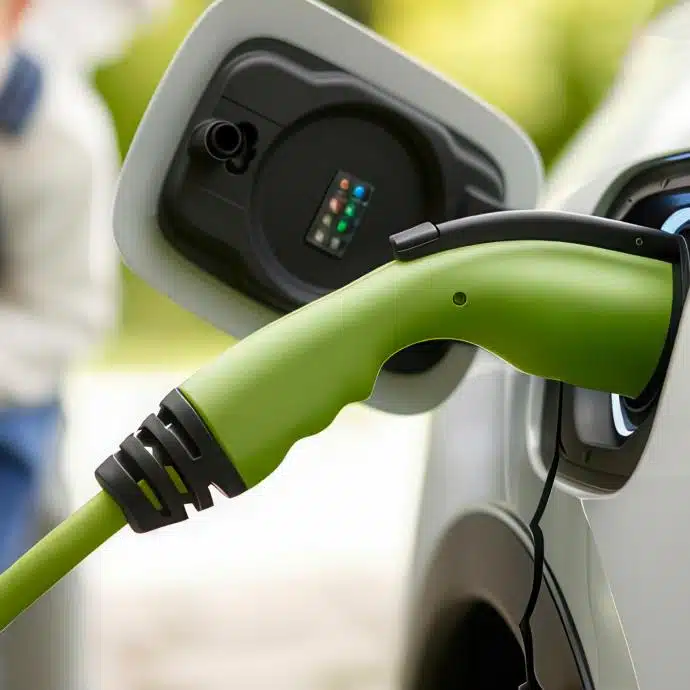


The relationship between EVs and electricity is straightforward: one is powered by the other. However, the dynamics between EVs and EV charging infrastructure are more nuanced.
Over 80% of EV charging occurs at home, mostly overnight while EV drivers sleep. Home charging does not need to be fast, and it does not require complex equipment; it can be as simple as plugging into a standard 110-volt outlet. Home charging is inexpensive, because residential electricity rates are much lower than the price gas car drivers pay at the pump; in gasoline terms, charging at home costs less than $1 per gallon equivalent. In fact, low-cost home charging is what unlocks EV affordability, making consumer access to home charging critical for increasing EV adoption. However, when EV drivers take to the road, they also need accessible, reliable public charging en route and at their destinations.
Along highway corridors, EV drivers rely on high-speed chargers, known as Direct Current Fast Chargers (DCFC), that operate more like gas pumps and can charge an EV battery in minutes. DCFC deployment needs to scale with EV market growth. One challenge is that DCFC are expensive to purchase, operate, and maintain. The many private-sector companies deploying DCFC rely on EV drivers paying a premium for high-speed charging, with the revenue from that premium supporting the business model. Hence, there is a balancing act to play: you need enough DCFC to make drivers and EV-curious consumers confident that they can safely embark on a road trip, and you need enough EVs on the road to make DCFC operation profitable.
When EV drivers arrive at destinations, they need access to slower public chargers, known as Level 2 chargers, at hotels, campgrounds, downtown parking decks, shopping centers, and entertainment venues. These public chargers function more like home chargers, allowing drivers to top off their batteries while they sleep, shop, eat, and play. Level 2 destination chargers cost significantly less than DCFC and help reduce their workload. When an EV leaves fully charged for the drive home or to the next destination, it needs to stop at fewer DCFC, thereby reducing the growing demand for high-speed charging.
The good news, as you will read below, is that DCFC and destination charging deployment are increasing as the number of EVs on the roads grows, making the business case and scalability of DCFC and Level 2 public charging viable, and ensuring traveling EVs stay charged.
Lawsuit Frees $5 Billion for National EV Chargers
It may be cold outside, but a major lawsuit win has unfrozen $5 billion for a national EV charging network. SACE joined nearly two dozen states and several fellow nonprofits in challenging the Trump Administration’s illegal freeze of National Electric Vehicle Infrastructure (NEVI) funding, clearing the way for states to implement the NEVI plans they’ve worked for years to develop and barring the federal government from unlawfully withdrawing states’ funds or interfering with states’ implementation. The ruling is not only a victory for the plaintiffs, but for EV drivers and the 211,000-plus Americans working in the EV, battery, and charging industries. Read more.

EV Chargers See Boost in Quantity and Quality
Speaking of EV chargers…the U.S. added a record number of public fast chargers last year, while operators also increased their reliability. The nation’s public fast-charging network expanded by 30% in 2025, with the addition of 18,041 ports. But that’s not all. Last year’s growth also included more ports per charging site to help reduce wait times at busy locations. And station reliability scores went up, now averaging 93% charging session success, which reflects better tech and station maintenance. All this led to a 30% bump in charging station utilization, with the nation’s network delivering a record 141 million public charging sessions. Read more.

EV Chargers Are Getting More Use
I can testify to this growth in charging station utilization personally. I recently attended an event at Georgia Tech in Atlanta to discuss strategies for strengthening the state’s battery manufacturing and mineral processing industries. Fortunately for me, GA Tech has installed a bunch of Level 2 chargers in its parking decks. Once upon a time, I was often the only EV plugged in. No longer. Not only were six other EVs charging when I arrived, but I was the only Tesla. Every other car was a different model from five brands: Jeep, Volkswagen, Kia, Hyundai, and Ford. This proliferation of makes and models is critical for reaching mass-market new-car shoppers. Read more.

Want to join the EV conversation? Let’s connect on LinkedIn!
SACE’s Electrify the South program leverages research, advocacy, and outreach to accelerate the equitable transition to electric transportation across the Southeast. Visit ElectrifytheSouth.org to learn more and connect with us.