

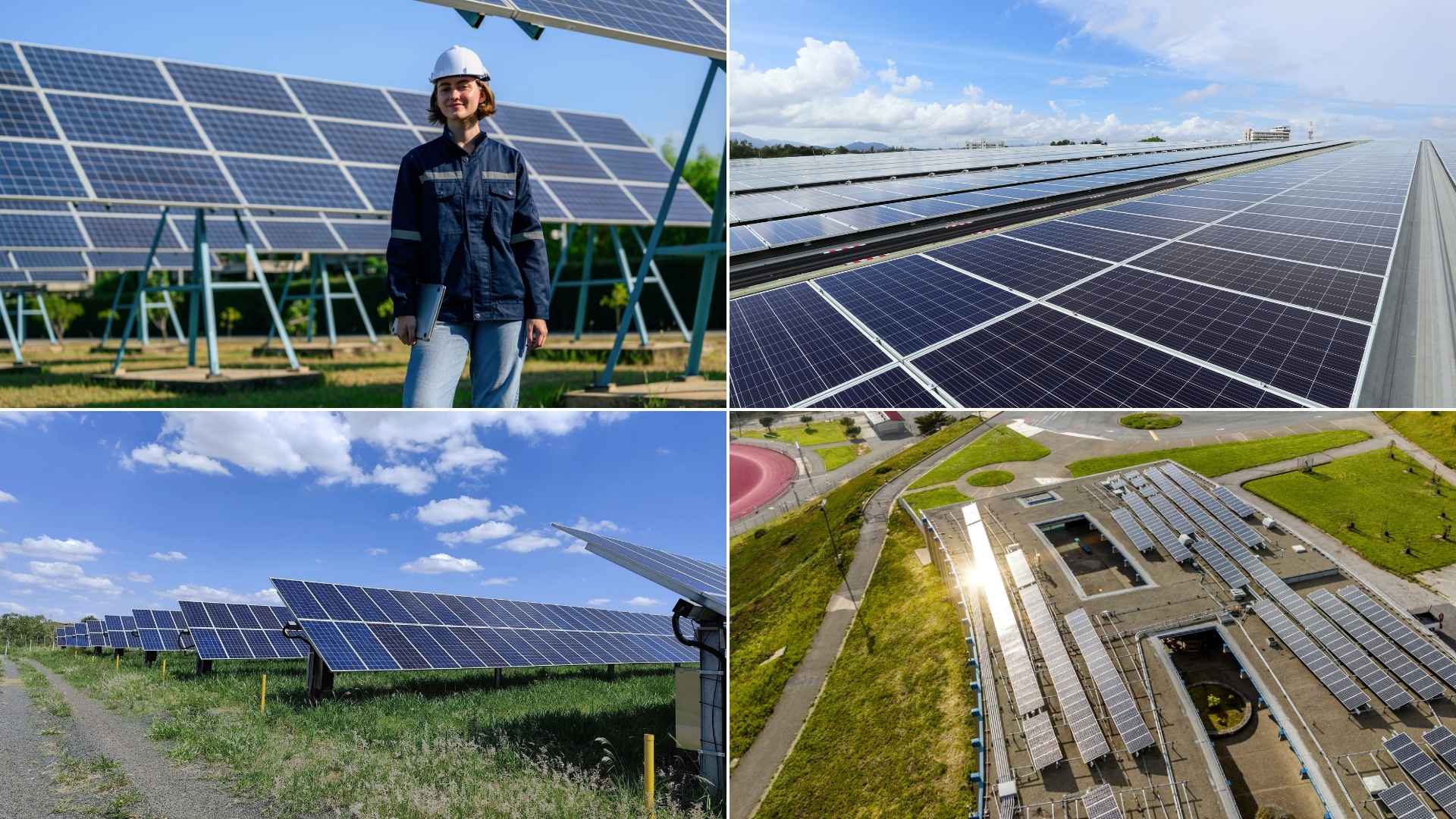
The Southeast solar market is growing rapidly, but risks losing momentum to fossil gas. SACE’s latest “Solar in the Southeast” report documents which utilities in the region have contributed most to get the Southeast to almost 30 gigawatts (GW) of installed solar capacity in 2025, and current plans that forecast nearly 54 GW installed in the region by 2030. Across the region, we see continued load growth forecasts driven primarily by data centers, while many utilities are pulling back future solar plans in favor of new fossil gas.

Sunrisers and Sunblockers
Nationally, 51% of planned capacity additions are solar. Of the major electric utilities in the Southeast, only the three major utilities in Florida are above this national average; solar makes up at least 70% of all new additions between now and 2030 for Tampa Electric, Florida Power & Light, and Duke Energy Florida. Other Southeast utilities, even those adding significant solar, are also adding non-solar resources, so that solar accounts for one-third or less of total capacity additions over this timeframe. Notably, the Tennessee Valley Authority (TVA) has not put out an updated Integrated Resource Plan (IRP), so it is not included in this evaluation.

Florida: The Leader Pulls Back
Florida’s solar installations grew to 15,500 megawatts (MW) in 2025 and are projected to reach over 28,000 MW by 2030, solidifying its leadership role in the Southeast. In particular, Florida has seen consistently high rooftop solar growth, in part due to its solar leasing program approved in 2018.
However, whether Florida’s solar growth will continue past 2030 remains an open question. Southeast solar leader Florida Power & Light (FPL) decreased planned solar over the next ten years by nearly 30% compared to its 2025 plan. The reasoning? Expiring federal solar tax credits. The result? Zero solar additions from 2031 through 2033. The gap filler? 3,200 MW of methane gas. Additionally, NextEra Energy, FPL’s parent company, quietly abandoned its goal of net-zero carbon emissions by 2045. This was not cited as a reason for the pullback of future solar.
Georgia: Data Centers and Commission Turnover
Georgia solar installations grew to almost 5,000 MW in 2025. Data centers and load growth needs are taking over the conversation in Georgia. The Georgia Public Service Commission, which regulates Georgia Power, gained two new Commissioners in November 2025, with more elections coming this November.
Learn more about the Georgia Public Service Commission elections.

TVA: At a Standstill
Tennessee Valley Authority’s (TVA) solar outlook is quite uncertain. The utility has not finalized an IRP since 2019. A draft IRP was released in September 2024, with a new IRP expected soon. With a change in presidential administration, a change across the TVA Board of Directors, and a change in TVA staff leadership, including the CEO, a new draft IRP is likely to look very different from the draft released in 2024.
Most disheartening is TVA’s 2026 resource solicitation, released in May 2026. This solicitation targets only existing resources, meaning no new solar additions.
TVA’s distribution utility customers, called Local Power Companies (LPCs), are seeking TVA’s permission to generate more of their own power, primarily through solar. So far, most LPCs have signed contracts with TVA that allow them to self-generate 3-5% of their own power. That percentage has not increased in years.
It is time for TVA to step up and answer the cry from its customers. More solar and flexibility, please!
The Carolinas: Will this momentum last?
North Carolina solar installations totaled almost 4,800 MW as of 2025, growing to nearly 8,000 MW by 2030. South Carolina’s solar installation capacity was just shy of 2,800 MW in 2025 and is projected to grow to just over 3,700 MW by 2030. While this shows great potential, legislative and regulatory changes are creeping in, making it harder to get there.
The North Carolina 2021 legislative goal to reduce emissions 70% by 2030 was removed in 2025. The North Carolina General Assembly has also changed the makeup of the North Carolina Utilities Commission (NCUC), likely impacting future resource plan decisions.
Duke Energy filed its Carbon Plan/Integrated Resource Plan (CPIRP) in North Carolina in October 2025. This plan projects less solar procurement in the near term than previously planned, but does increase battery storage. In an unexpected hit to solar, the NCUC Chairman paused Duke’s 2026 solar RFP in April 2026 until after the 2026 CPIRP order is issued. This disrupts the development of solar across Duke’s territories in North and South Carolina.
Finally, but not to be overshadowed by these developments, Duke Energy withdrew customer solar programs in NC and SC: Clean Energy Connection, a community solar program, and Clean Energy Impact, a renewable energy credit offering. On the brighter side, the NC residential PowerPair pilot has been successful and seen great interest, and a non-residential storage program has been approved in SC. What is next for these programs? A lot is riding on Duke and the Commissions in North and South Carolina.
At a possible inflection point
We are at a critical point in solar growth. 30 GW of solar in the Southeast is great progress, and 54 GW by 2030 would be a win. However, this report is a warning. The slowdown we are seeing is a result of legislative and regulatory changes. Utilities are choosing methane gas over solar to serve data center demand. Will the Sunrisers stay the course? Will all utilities be held accountable to the projections in their integrated resource plans? We are calling on the utilities, regulators, and policymakers to stay strong and get us to at least 54 GW by 2030.