

When Dave Sillman and his family started their hunt for a new house, they had no idea that come December 2025, they’d move into a home powered by solar energy and kept comfortable by a geothermal heating and cooling system. It’s what Dave, an early adopter of solar energy and committed environmental advocate, calls an “amazing coincidence.”
Dave is no stranger to how clean energy technologies like solar, battery storage, energy efficiency, and electric transportation can work together to save energy and lower power bills; he’s installed solar three times, prioritized weatherization, and drives an EV. “Normally,” Dave says, “When I get a new house, the first thing I do is start working on that.” Now, he can add geothermal energy to his list.
Dave’s Metro, Atlanta home is a testament to the interconnectivity and growing affordability of clean energy tech. Learn more in our Q&A with Dave below.
But First: What is Geothermal Energy?
Geothermal systems are a type of heat pump — a highly efficient, all-in-one HVAC system that both heats and cools your home. While furnaces burn fuel to generate heat, heat pumps use electricity and refrigerant to move heat, pulling heat out of your home in the summer and reversing the process to pull warmth inside in the winter. By moving heat rather than creating it, heat pumps use less power to produce the same amount of heating and cooling.
Geothermal systems are essentially ground-source heat pumps. This means they move heat between aboveground and underground, instead of between inside and outside air like air-source heat pumps do. Installers drill wells to bury rods that are heat exchangers so the system can tap into the heat of the ground.
Let’s learn more about how geothermal energy works for Dave’s family, and works alongside other clean energy technologies like solar power and batteries.

Give us a rundown of the clean energy tech at work in your home.
Our home came with a 17 kW solar array and three Tesla Powerwalls (batteries that store excess solar energy we don’t use). The previous owners did go way further with batteries than I would have, and I’m so glad they did!
Looking at my Tesla app in June, 34% of my power came from solar energy stored in the batteries, 38% came directly from the solar panels as energy was generated, and 28% came from the grid. That can be translated to monetary savings.
Then there’s the geothermal system. The solar and the batteries are sources of electrons — they’re where I get my power from. The geothermal system is a draw on electrons — it uses electricity to heat and cool my home, but at a much lower (and cheaper) draw than a gas furnace or normal HVAC system would.
I knew that geothermal was available for residential use, I just didn’t know a lot about it before finding this home. It’s a weird coincidence: when my wife brought me to look at the home for the first time, I’d just finished taking a certificate program about financing and deploying clean energy, and it just happened to be “geothermal week” in my course. It was exciting.

How do your power bills in this home compare to those at previous homes?
We’ve only lived here a few months, but the power bills have been about $35 a month, with the highest being $150 in the wintertime. I expect our average power bill to be in the $60 – $70 range. I went from a $600 Georgia Power bill in my old house without solar, batteries & geothermal, to this
Our geothermal system heats and cools our home 70% cheaper than a furnace and air conditioner. HVAC is a home’s biggest draw, and our geothermal system is orders of magnitude more efficient than a traditional gas furnace and AC. So, my biggest energy user is now really efficient. The evidence is my power bill.
Our solar array powers our electricity usage all day, and our batteries power us at night. It’s one big system — it’s a combination. And since geothermal systems throw off excess heat, that heat goes into my water heater so I save money on water heating, too. It’s all interconnected.

You drive electric vehicles (EVs). How does that factor into your home’s ecosystem of clean energy?
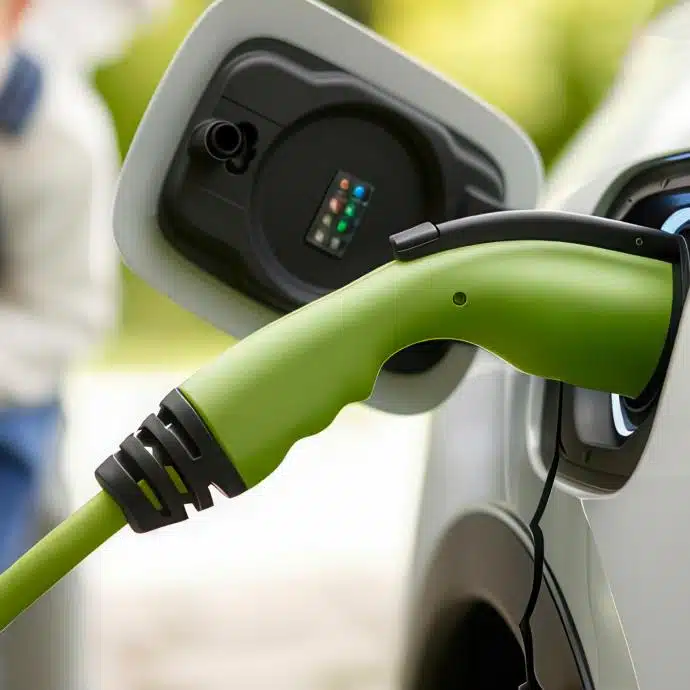
We’re a two‑EV family with a Tesla and a Hyundai Ioniq. We charge our electric vehicles with the electricity our solar panels generate — specifically excess electricity. Sometimes solar panels generate more energy than you can use, especially mid-day when the sun is strongest. Since Georgia doesn’t have net metering, you want to sell as little solar power you don’t use back to the grid as possible. I use Tesla’s ‘Charge on Sunshine,’ which prioritizes charging our Tesla on excess solar. For the Ioniq, I just keep an eye on things and try to charge in the middle of the day when I know we’d be pushing power back to the grid.
What are the biggest pros and cons of your geothermal system?
The biggest pro is the efficiency compared to a traditional gas furnace and AC, which translates into dollars and cents saved. Heat pumps are also great for the climate; if everybody had heat pumps, we’d solve a big chunk of the climate problem. All heat pumps, not just ground-source geothermal, are great.
My main con is that there are fewer service providers. I had to research pretty thoroughly to find a contractor to inspect the geothermal system before we moved in because I didn’t know anything about it. Fortunately, there’s at least one or two really good companies in the Atlanta area, but overall, it’s trickier to find service.
The other con is the upfront cost, which dissuades people. But the payback is handsome: you’ll make your money back a few times over. If you borrow money to install geothermal, you can often structure the loan where the payments are lower than your energy savings. You can also do that for solar panels. There’s still plenty of solar financing out there.
Other than that, it’s just like owning a regular AC system. You get seasonal maintenance a couple times a year, you change filters… aboveground, for all intents and purposes, it’s just like any heat pump.
What motivates you to fight for a transition to clean energy?
There are two things that drive me. One is the science: it’s real and it’s dire. I have a daughter, so it’s absolutely real and dire.
The other is that we already have the solutions, and they’re cheaper and better. The clean energy transition itself, experts will tell you, is the greatest economic opportunity of our lifetime. It’s also an amazing social opportunity: we can address environmental racism to make life a little easier and better for folks who are struggling, and make everybody healthier. Then there’s the health impacts: experts say the cost savings in healthcare dollars saved by getting off fossil fuels would pay for the whole energy transition.
So, it’s both fear and excitement that drive me.
Do you have any advice for folks who want to install clean energy systems in their home?
Best practices are that you start with efficiency and air sealing—weatherization, all that. If folks want to start taking the first few steps, it starts with tightening up your house, getting out the caulk gun, blowing some insulation. You don’t have to go all in and get solar. There are still programs here in Georgia where folks can get subsidies for efficiency upgrades, including switching to a heat pump.
As an environmental advocate, what do you think we can do as citizens to make clean energy technologies like geothermal energy more accessible and abundant?
I’m on the board for Georgians for Affordable Energy, which is all about trying to fix how Georgia Power operates and how the Georgia Public Service Commission (PSC) works. (Learn more about the importance of the Georgia PSC in SACE’s article here.) Georgia Power is exploitative: it works in a cost‑plus revenue model, so they get a guaranteed return on whatever they spend. Naturally, they want as many expensive power plants as possible, as big as possible, because then they make more money. We have to change the regulatory structure and get better, more knowledgeable PSC commissioners elected.
The most important thing anybody can do, in the big scheme of things, is voting. Not just for the PSC, but voting for people who get it, who understand that the science is real and we have the solutions. The one thing stopping us is a lack of good policy.


