


A coalition of churches in Atlanta’s westside is redefining what it means to prepare a community for the future. The Westside Resilience Corridor is not a city initiative, a utility program, or a climate project, although it draws on all three. At its core, the Westside Resilience Corridor is a community-driven effort to address the everyday and emergency needs of residents who have long been underserved, using clean energy infrastructure as a tool rather than an end in itself.
A Spark at Vicars
The story begins at Vicars Community Center, the community hub operated by Community Church Atlanta and its senior pastor, Rev. Dr. Kevin W. Earley. In 2024, Groundswell — a national nonprofit that develops clean energy solutions for underserved communities — partnered with the church to build what became the first community-owned resilience hub in the state of Georgia.
The hub was conceived as a demonstration project: a way to show what was possible even in what Matthew Wesley Williams, Groundswell’s point person on the Corridor, diplomatically calls a “non-enabling policy environment.” It worked. When Atlanta Mayor Andre Dickens visited the site, he spoke about using unused municipal land for similar facilities. Philanthropic partners took notice. And along Cascade Avenue and Ralph David Abernathy Boulevard, the thoroughfare that cuts through the heart of southwest Atlanta, the pastors of several historic churches began asking an innovative question: What if we did this together?
Williams, whose background is in ministry rather than energy, made a few calls. In addition to Rev. Dr. Kevin W. Earley at Community Church, Williams connected with Damon Williams at Providence Missionary Baptist Church, long active in environmental justice work; Cedrick von Jackson at West Hunter Baptist Church, whose most celebrated former pastor was the civil rights leader Ralph David Abernathy; and Reverend Richard Bright, a long-time advocate for environmental health and justice. Those conversations grew into a coalition, and the coalition grew into the Westside Resilience Corridor.
Rev. Cedrick Von Jackson, who has led West Hunter for nearly five years since relocating from North Mississippi, was already part of the relational fabric before the resilience work began. He and Pastor Damon Williams at Providence had developed a friendship close enough that their two congregations began sharing New Year’s Eve watch night services. When Matthew Wesley Williams brought him to see what was being built at the Vicars Center, Jackson says the concept clicked immediately.
“Once he showed me what they were doing, I was sold, I was on board.” What sealed it, he adds, was recognizing the stakes: “I told Matthew that this is not just philanthropic work. This is real ministry work, where you are helping people get their needs met.”
What the Community Said It Needed
From the beginning, Groundswell was deliberate about one thing: they would not set the agenda.
“Groundswell did not determine that,” Williams says plainly, when asked which priorities shaped the project. Instead, the organization convened the churches and their community leaders and asked them to identify what mattered most to the people they served.
The answer did not include “climate change” or “clean energy.” It included four things: housing affordability, efficiency, and quality; workforce and economic development; food systems and food security; and comprehensive health.
“Notice they did not say climate change. They did not say clean energy,” Williams observes. “Where they are focused is on the flesh and blood, everyday realities of the communities that they serve. These clean energy solutions help to serve those flesh and blood priorities.“
This framing — clean energy as a means, not a mission — shapes everything about how the Corridor operates.
Four Pillars of Work
With those community priorities established, the coalition organized its work into four interconnected areas.
Home Energy Efficiency and Pre-Weatherization
Residents in the Corridor pay a disproportionate share of their income on energy bills — in the worst cases, between 10 and 15 percent annually, compared to the 1 to 2 percent paid by more affluent households elsewhere in the city. The culprit is largely aging, neglected housing: heat escaping through drafty windows, poorly insulated walls, and outdated systems.
Williams quotes his colleague Michelle Moore: “People pay bills, they don’t pay rates.” Abstractly lower rates mean little if the underlying infrastructure is losing energy. Weatherization and efficiency upgrades directly cut household bills while also tackling mold, asbestos, and other health hazards baked into old homes.
Home weatherization and efficiency includes upgrades such as improved attic insulation, air sealing, Wi-Fi thermostats, and heat pumps. This work also overlaps with city investment priorities — the mayor has designated parts of the Westside for focused neighborhood reinvestment — and carries longer-term grid benefits, as well-weatherized homes reduce overall demand and risk.
Resilience Hubs
Solar panels and battery storage systems are being installed at each of the four anchor churches along the Corridor. On a normal day, these systems reduce energy costs for the churches, freeing up funds for their community missions. On a bad day, such as a major storm or a prolonged grid outage, they become something life-saving.
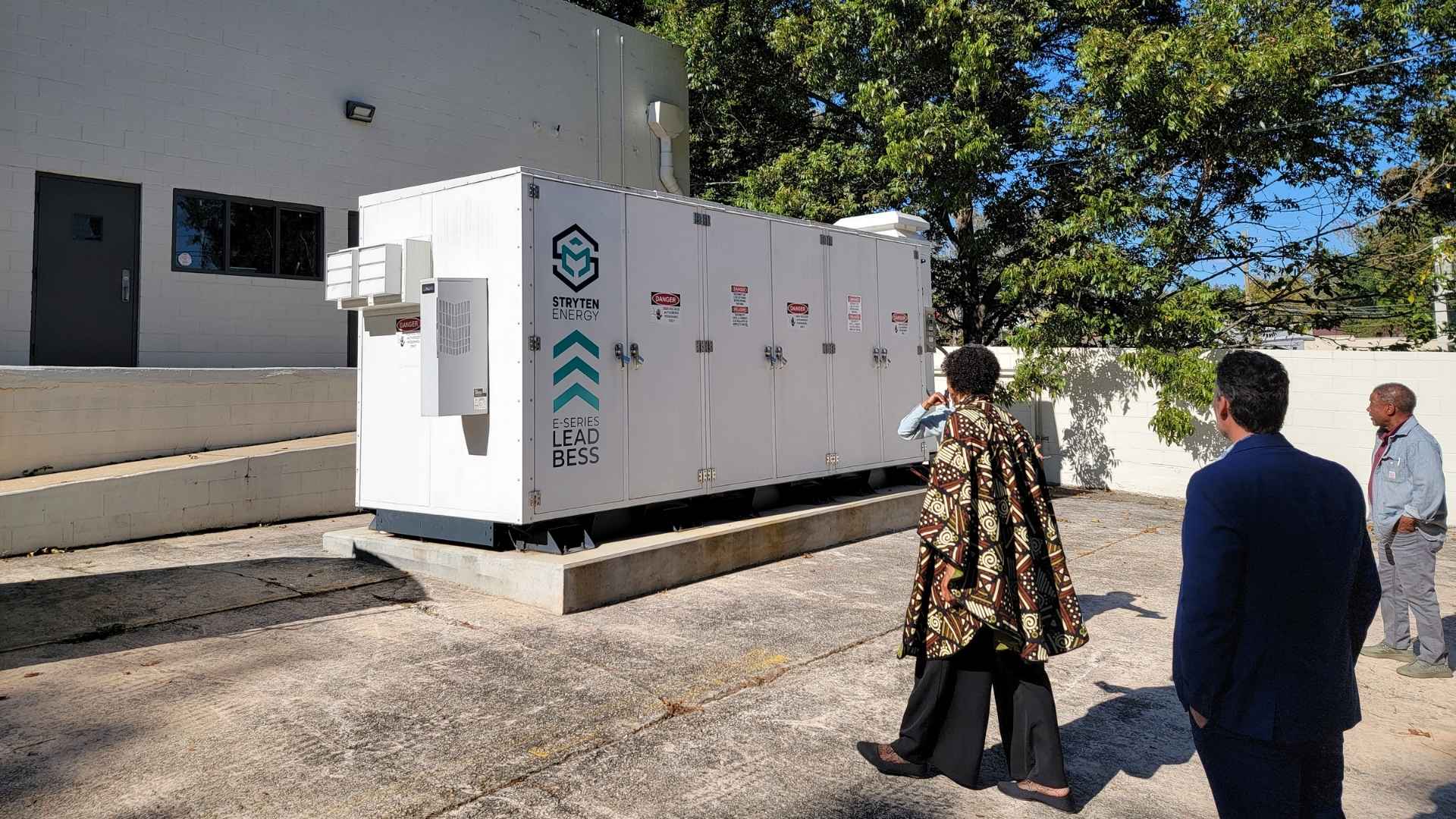
Williams explains the design in plain terms: the battery is sized to power “critical load” for up to three days without sun. Critical load means only what the community truly needs in a crisis: a fellowship hall with a kitchen, refrigerators for insulin and breast milk, lights, bathrooms, and charging stations for medical devices.
“This is where people come to heat, to cool, to refrigerate, to plug in and to be in community,” he says.
The batteries also serve the grid. Through a program with Georgia Power, the storage systems function as grid assets during peak demand periods, providing revenue back to the church and helping manage grid reliability for everyone.
Workforce and Economic Development
In March, the Corridor launched a pre-employment training program at Vicars Community Center. The response was striking: nearly five times as many applicants as available slots. The program, developed in partnership with Georgia Power, the City of Atlanta, and Vicars, offers pathways into energy-sector careers with built-in employment placement.
The city contributed wraparound services to help participants navigate real-life barriers: transportation, childcare, and the various crises that can derail someone trying to build a career. Graduation for the first cohort was on May 11, with the mayor as keynote speaker. Placement had already begun before graduation day arrived — one participant landed a warehouse operations role at Home Depot just two weeks into the program.
“About half of the cohort before the program was over had already received job offers,” Rev. Jackson says. “We’re excited about that work, but we know that these times are times when people need gainful employment.” He hopes future cohorts will not have to be capped at 20.
Community Resilience Planning
The fourth element is a planning process that invites residents into the design of the hubs themselves, asking questions like: What does resilience mean to you? What resources does this community need in a crisis? Where else along the Corridor might a hub be beneficial? What services should each location offer?
This work draws on a framework Groundswell developed over two years with The National Laboratory of the Rockies, formerly known as the National Renewable Energy Laboratory (NREL), and other partners in Maryland, combining an energy resilience metric called “critical service accessibility” with a community design process.
Why Churches?
Faith institutions are central to the Corridor model, but Williams is quick to clarify that not every church qualifies as a resilience hub.
“It really is about their track record,” he says. Vicars Community Center was already feeding roughly 400 families a week before a single solar panel was installed. It already hosted the Concerned Black Clergy, neighborhood planning unit meetings, and a range of civic gatherings. It had already earned the community’s trust. The same is true of West Hunter, Providence Missionary Baptist, and Atlanta Good Shepherd — long-distance runners, as Williams puts it, in community-oriented ministry.
That trust matters practically. “You might say technically this church would be ideal,” Williams explains, “but then the community says, ‘No, those folks are mean, I’m not going there when the rubber hits the road.'” The technical siting criteria and the community’s social knowledge have to align.
The churches also bring something else: a relational infrastructure. They already gathered for joint worship services. They already had relationships with one another. The resilience Corridor gave those relationships a new purpose — collaboration not just in ministry but in the material life of the neighborhood.
That collaboration has not been without friction. Rev. Jackson is candid about the skepticism his congregation initially brought to the project — skepticism rooted in past promises from outside entities that never materialized, and a reasonable wariness about what Georgia Power and other large partners stood to gain.
“There’s been a level of skepticism that we have had to overcome, and that we are still, honestly, still overcoming,” he says.
What has helped shift opinion, he notes, is a combination of demonstrated impact and concrete self-interest. The partnership helped West Hunter identify a Georgia Power billing structure — a time-of-use rate plan — that the church had never heard of, and that analysis projected at least $13,000 in annual savings from the rate switch alone, before any solar or storage is installed. Once the full system is in place, Jackson anticipates savings of 35 to 40 percent on the church’s current utility bill. “When you start talking about cutting, at a minimum, $13,000 from your yearly utility bill,” he says, “those kinds of touch points make a difference.”
He also sees the coalition itself as sending a message beyond energy: churches working together rather than competing. “Unfortunately, churches tend to operate in silos,” Jackson says. “With us working together as a collaboration and the fellowship of these four churches, I think we’re showing the community that there is another way, that churches don’t have to compete. We are all in the same neighborhood. We are all truly part of the body of Christ.”
Navigating a Non-Enabling Environment
The policy environment for community solar, resilience infrastructure, and equitable energy investment is less developed in the Southeast than in states with more progressive utility regulation. Rather than treating that as a reason to wait, the team is treating it as a design constraint. They are focusing on partnerships with municipal utilities and cooperatives, which have more regulatory flexibility. They are braiding philanthropic capital with existing affordability programs. And they are building projects into actual, physical infrastructure that demonstrate what is possible and give regulators and utilities something concrete to respond to.
“We build stuff, and when we build stuff, that becomes a kind of catalyst for education and expanding the imagination of folks who have responsibility for building policy,” Williams says.
The Vicars hub is a case in point: a single demonstration project that helped animate the imagination of a mayor, a utility, and a philanthropic community.
The framing matters too. Williams is deliberate about describing this work not in ideological terms but in kitchen-table ones: cutting bills, building local resilience, supporting local jobs, keeping critical facilities powered.
“When you start talking about the kitchen table,” he says, “that’s where common ground exists, and that’s where you’re able to begin to build a table with what may seem like unlikely allies.”
Partnership With Georgia Power
The utility relationship is complex. What made the partnership possible, Williams argues, was formally defining the process. Groundswell and the churches developed formal covenants — documents that articulated not just what the partners intended to do together, but how they would show up. When a partner grew frustrated at the time that process was taking, Williams offered a reframe: “This is the work. This work moves only at the speed of trust. You have to slow down early so you can speed up later.”
Crucially, Groundswell committed to holding the table rather than controlling it — to supporting the community’s agenda rather than supplanting it. “We will not be the 800-pound gorilla that comes in and sucks up all the air and drives the agenda,” he says. That posture, combined with the genuine shared interest in affordability and reliability, created space for a partnership that has produced tangible results.
A Framework for Resilience
Underlying all of this work is a conception of resilience as a daily struggle, not an emergency response.
“What if ‘emergency’ is not an episode, it’s chronic?” Williams asks. In communities that have faced chronic disinvestment, an emergency is not a rare occurrence — it is a condition. What does resilience mean when the crisis is not a hurricane but a decades-long pattern of neglect?
Groundswell’s answer rests on three pillars. The first is access to critical resources and infrastructure — not just energy, but healthcare, food, employment, and emergency services. The second is connection to community: the social infrastructure of neighbor-to-neighbor relationships and interwoven local institutions that determines where people actually go when things fall apart. The third is local participation in decision-making.
“People ought to have a say in what happens where they live,” Williams says. “People who are closest to the problem understand what solutions need to look like. When you trust that kind of collective and local wisdom and collaborate in ways that design around that, you get better outcomes. It’s just consistently true.”
What people bring to that table, he adds, is not just preferences or data points. They bring what one Georgia Power associate involved in the project described as “a trauma-informed approach” — generational histories of triumph and of harm. Atlanta’s west side is, in Williams’s phrase, “a tale of two cities, sometimes in the same neighborhood.” It is the cradle of the civil rights movement and home to some of the highest energy burdens in the metro area. Both of those things are true, and both shape what resilience has to mean there.
The Westside Resilience Corridor is, in that sense, less a project than a practice — a long-term commitment to stitching together the technical and the social, the immediate and the generational, in service of a community that has been asked to wait long enough.
For pastors elsewhere in the Southeast considering something similar, Rev. Jackson offers a clear-eyed two-part message: “Step out on faith. Know that this is real ministry work. But also do your research.” Just as important, he says, is finding partners with the capacity to carry the weight — because the financial and logistical demands of multi-million-dollar infrastructure projects are not something a single congregation can bear alone. “Groundswell and all the partners have done all the heavy lifting as far as securing funding and the planning and all of those pieces,” he says. “Make sure that the entities that you partner with have the capacity to do that without placing extra burden on the church.”


